

Dogecoin (DOGE), the leading memecoin of the crypto world, has solidified its position as a dominant global payment network in 2026. With the full implementation of the Doginals (DRC-20) protocol and the integration of DOGE as a primary tipping currency on major social platforms, the demand for network security has never been higher. As of February 2026, Dogecoin’s hash rate has reached record levels, fueled by a robust AuxPoW (Merged Mining) relationship with Litecoin. This synergy allows miners to secure two major networks simultaneously, earning both DOGE and LTC rewards without increasing electricity consumption.
In 2026, Dogecoin mining is no longer a race for GPUs; it is a battle of specialized Scrypt ASICs. With the network's inflation rate dropping below 3% and daily transaction volumes hitting tens of millions, the role of miners has shifted from speculative shibes to the backbone of a multi-billion dollar on-chain economy. This guide breaks down the top 5 Dogecoin miners of 2026, evaluating their profitability, energy efficiency, and suitability for the modern Dogeverse, and how you can trade your mined DOGE coins on BingX.
What Are the 5 Best Dogecoin Miners to Use in 2026?
The 2026 mining landscape is defined by efficiency-to-hashrate ratios. The following hardware leads the market in performance and reliability.
1. Bitmain Antminer L9
The Antminer L9 is the powerhouse of the 2026 Scrypt market, delivering a massive 17 GH/s hashrate with a best-in-class power efficiency of 0.20 J/MH. Engineered with Bitmain's latest 5nm chip architecture, the L9 is specifically optimized to handle the intensive data verification required by the DRC-20 inscription boom. At a consumption of 3360W, it maximizes the revenue-to-footprint ratio, allowing industrial farms to pack more hashing power into existing rack space while maintaining a steady net profit of approximately $12.55/day (at $0.07/kWh).
Key Consideration: The unit generates 75 dB of noise and requires a 220-240V circuit, necessitating dedicated industrial cooling and soundproofed infrastructure to prevent hardware throttling.
Best Suited For: Institutional-grade mining operations and farm operators seeking maximum aggregate hashrate and the fastest ROI in high-difficulty environments.
2. ElphaPex DG1+
The ElphaPex DG1+ stands out in 2026 as a rugged alternative to Bitmain, delivering a reliable 14.4 GH/s hashrate at 3950W. It features a specialized aluminum alloy chassis with high-density heat sinks and four 12038 fans, designed to maintain an optimal operating temperature of 25°C - 35°C even under continuous load. While its power draw is higher than the L9, its hardware stability ensures a near-zero failure rate, making it a favorite for miners who prioritize consistent uptime over raw efficiency.
Key Consideration: The higher power consumption necessitates robust electrical infrastructure, but the DG1+ often features more accessible firmware for custom overclocking or undervolting.
Best Suited For: Mid-scale mining operations in warmer climates that require durable hardware capable of 24/7 high-performance output with minimal maintenance.
3. Fluminer L1 Pro
The Fluminer L1 Pro is the premier prosumer choice for 2026, offering a crisp 6 GH/s hashrate at a manageable 1400W consumption. It bridges the gap between hobbyist and professional mining by utilizing enterprise-grade silent fans that keep noise levels at a modest 45 dB, roughly the volume of a standard refrigerator. The L1 Pro is highly practical for non-industrial settings as it can often run on high-capacity residential circuits without requiring a complete panel upgrade, all while providing a stable net profit of $4.20/day.
Key Consideration: It features a unique dual-mode interface allowing users to switch between Performance and Efficiency modes to adapt to fluctuating electricity prices.
Best Suited For: Serious home miners and small office setups that demand professional hashing power without the extreme heat and noise of industrial rigs.
4. VolcMiner D1 Mini Pre
The VolcMiner D1 Mini Pre redefined entry-level efficiency in early 2026, packing 2.2 GH/s into a compact 4.7kg frame that consumes only 500W. With an efficiency rating of 0.23 J/MH, it is the most energy-conscious ASIC in the 2-3 GH/s bracket, making it ideal for users utilizing solar arrays or small-scale renewable energy setups. Its plug-and-play Ethernet interface and simple web-based dashboard allow for a 5-minute setup time, making it the most practical "earning tool that still generates a meaningful net profit of $1.60/day.
Key Consideration: While compact, the D1 Mini Pre lacks internal sound dampening, so it should be placed in a ventilated closet or garage to isolate the constant fan hum.
Best Suited For: Beginners and Green miners who want to participate in the Dogeverse with high-efficiency hardware that fits on a standard bookshelf.
5. ElphaPex DG Home 1
The ElphaPex DG Home 1 is the 2026 benchmark for silent, apartment-ready mining, delivering 2.1 GH/s at a low 630W draw. Designed with an aesthetics-first approach, it mimics a high-end desktop PC and maintains a noise profile of under 45 dB, ensuring it can run in a living room without disrupting daily life. It is purpose-built for the Set and Forget miner, featuring a robust auto-restart function and thermal sensors that automatically adjust fan speed based on ambient room temperature to ensure it never exceeds 65°C.
Key Consideration: The 630W draw is comparable to a high-end gaming PC, making it safe for standard household outlets, though its ROI period is longer due to lower raw hashrate.
Best Suited For: Apartment dwellers and casual enthusiasts who want a quiet, low-maintenance way to accumulate DOGE and LTC rewards while supporting network decentralization.
How to Trade Dogecoin (DOGE) on BingX
While mining builds your long-term position, BingX provides the tools to manage your DOGE liquidity and capitalize on market volatility in real-time.
Buy and Hold DOGE on the Spot Market
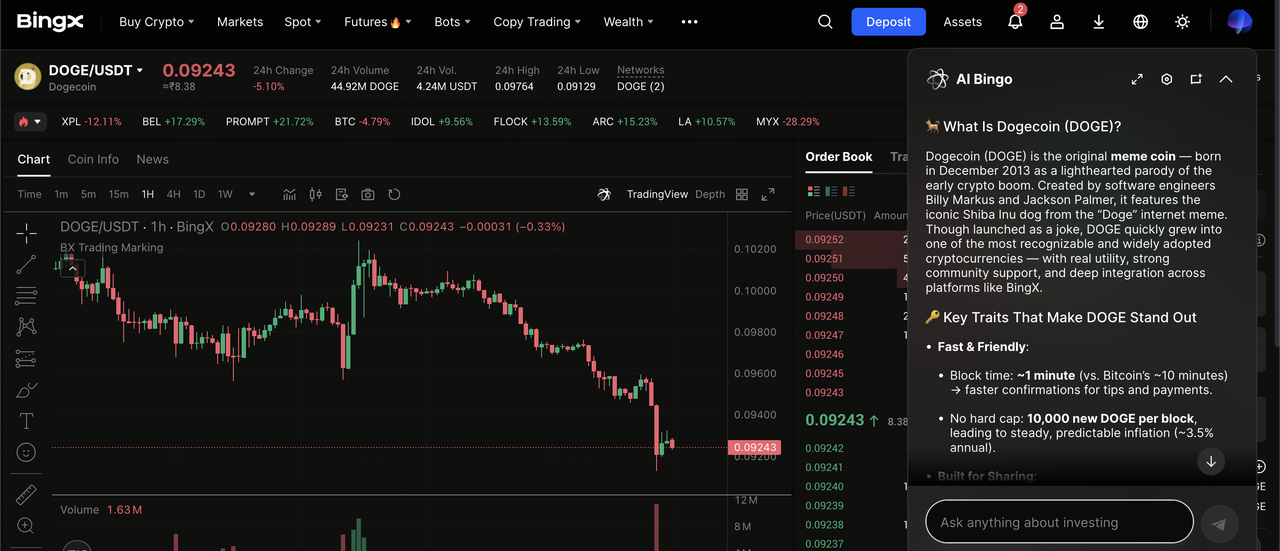
DOGE/USDT trading pair on the spot market powered by BingX AI insights
2. Leverage BingX AI analytics to identify optimal entry points during network upgrades or viral social trends.
3. Use the ChainSpot feature to swap your mined DOGE for other high-potential memecoins directly.
Hedge Your Mining Risk with DOGE Futures
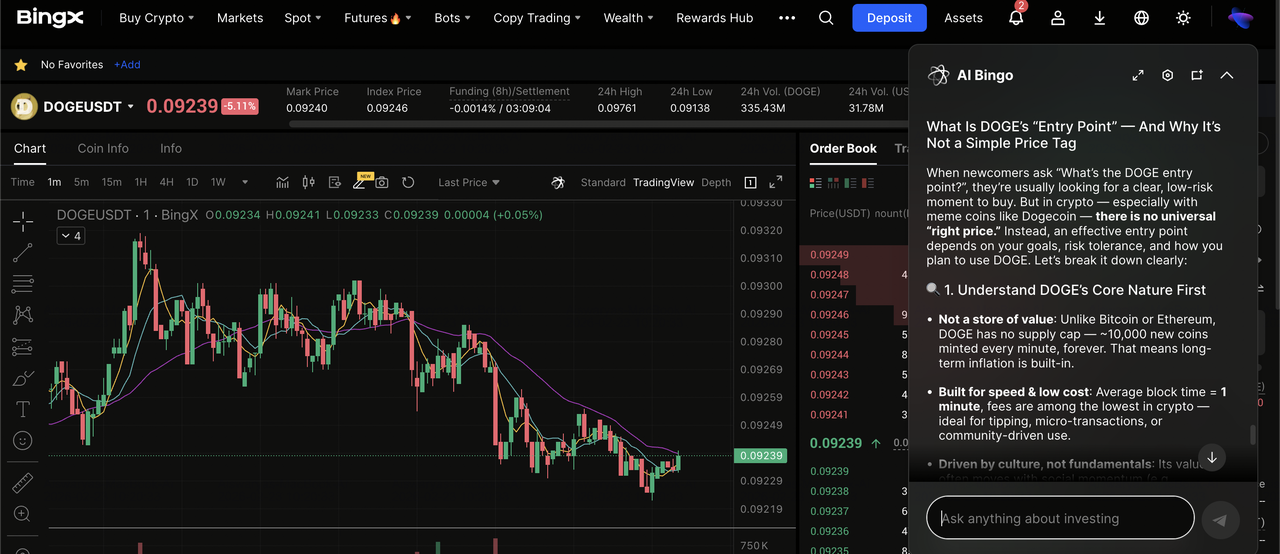
DOGE/USDT perpetual contract on the futures market featuring BingX AI insights
1. Transfer USDT to your Futures account and select the DOGE/USDT Perpetual contract.
2. If the market turns bearish, use leverage to open a Short position, hedging your physical mining hardware's daily output.
3. Apply Stop-Loss and Take-Profit orders to automate your strategy while you focus on maintaining your rig.
How to Choose the Best Dogecoin Miner for You
Selecting a miner in 2026 requires a cold calculation of your local energy costs and infrastructure limits.
The DOGE Mining Selection Checklist
1. Voltage Requirements: Industrial units like L9 and DG1+ strictly require 220V-240V; residential units like DG Home 1 can run on 110V-120V.
2. Noise and Heat: An L9 produces as much heat as a large space heater; plan for an exhaust system if mining indoors.
3. Pool Selection: Ensure you join a pool that supports LTC+DOGE Merged Mining to avoid leaving 30-40% of your potential revenue on the table.
4. Network Difficulty: Monitor the global hashrate; as more L9s come online, the share of the block reward for smaller miners decreases.
5. Payout Thresholds: Check if your mining pool’s minimum payout matches your daily output; small miners may only receive payouts weekly.
Top 3 Considerations Before Mining Dogecoin
Before committing capital to specialized Scrypt hardware, investors must evaluate the macro-economic and technical factors that dictate long-term sustainability in the 2026 mining landscape.
1. Dogecoin's Soft Halving and Mining Difficulty: Unlike Bitcoin’s discrete halving events, Dogecoin’s fixed annual issuance of 5.25 billion DOGE results in a naturally decaying inflation rate, currently 3.4% in 2026, which, combined with surging network difficulty, can reduce the Satoshi-value of older rigs by 20–30% annually.
2. Doginal Congestion and Fee Revenue: The 2026 inscription craze, driven by DRC-20 tokens and Doginals, now accounts for up to 40% of daily block rewards during peak congestion; high-hashrate miners like the Antminer L9 are better positioned to capture these lucrative priority fees compared to entry-level units.
3. The $0.12/kWh Profitability Threshold: In the current competitive climate, the break-even electricity rate for most Scrypt ASICs sits at $0.12 per kWh; if your local utility costs exceed this figure, your operational expenses will likely outpace your rewards, making direct accumulation via BingX Spot a more capital-efficient strategy.
Final Thoughts: How to Optimize Mining Dogecoin in 2026
By early 2026, Dogecoin mining has transitioned from a hobbyist pursuit into a specialized industrial sector defined by high-efficiency Scrypt ASICs and merged-mining synergy with Litecoin. Whether deploying a silent ElphaPex DG Home 1 for residential accumulation or an industrial Antminer L9 for large-scale hash power, your hardware plays a critical role in maintaining the decentralization and security of the Dogecoin network.
Integrating your mining output with the professional-grade ecosystem on BingX, from AI-driven market analytics to unified TradFi portfolio management, allows for a more structured approach to managing your digital assets. This synergy enables miners to pivot quickly between holding DOGE and hedging into lower-volatility assets like gold or indices when market conditions shift.
Risk Reminder: Cryptocurrency mining involves significant financial risk. Profitability is highly sensitive to fluctuations in the market price of DOGE and LTC, changes in global network difficulty, and local electricity costs. Hardware is subject to rapid obsolescence and physical wear. Never invest more capital than you can afford to lose, and ensure your mining strategy accounts for potential periods of negative net returns.