

Block Street is a liquidity infrastructure protocol built to support the next generation of on-chain capital markets. Designed to address liquidity fragmentation in tokenized equities and real-world assets (RWAs), Block Street provides institutional-grade execution infrastructure that connects traditional finance with decentralized settlement. Launched in early 2026 after raising $11.5 million, the protocol introduces a Unified Liquidity Layer that links tokenized stocks, RWAs, and DeFi markets into a single composable system.
$BSB is quickly gaining attention within the RWA and tokenized equities narrative. Following its Token Generation Event (TGE) on March 4, 2026, the token was listed on major crypto exchanges, signaling strong institutional and retail interest. With backing from investors with backgrounds at Citadel, Point72, Jane Street, and Hudson River Trading, Block Street aims to combine Wall Street–grade execution with Web3 composability.
This article explores how Block Street’s Unified Liquidity Layer works, the utility of the $BSB token, and how to trade BSB on BingX.
What Is Block Street (BSB) and How Does It Work?
Block Street operates as a Unified Liquidity Layer for tokenized capital markets, designed to solve the problem of fragmented liquidity across on-chain assets. As tokenized equities, derivatives, and real-world assets (RWAs) expand across different blockchains, liquidity becomes scattered across isolated pools and protocols. Block Street aggregates these markets into a shared liquidity layer, improving price discovery and capital efficiency across chains such as Ethereum, BNB Chain, and Monad.
The protocol is built around two flagship products and a core infrastructure engine:
• Aqua, Cross-Protocol Liquidity Network: Aqua is Block Street’s RFQ-based execution engine that aggregates liquidity from market makers, institutional desks, and on-chain pools. Instead of relying solely on AMM liquidity, Aqua sources quotes across multiple venues to deliver tighter spreads and lower slippage for tokenized asset trading.
• Everst, Leverage and Liquidity Protocol: Everst enables users to borrow, hedge, and generate yield using tokenized equities as collateral. By allowing structured capital reuse, the protocol introduces lending and leverage functionality tailored for on-chain stocks and RWAs.
• Hybrid Liquidity Engine: At the core of the system is Block Street’s Hybrid Liquidity Engine, which combines off-chain market-making infrastructure with on-chain settlement. This architecture improves execution efficiency while maintaining the transparency and composability of DeFi, allowing institutions and developers to access unified liquidity through a multichain API.
Who Is Behind Block Street?
Block Street was co-founded by Hedy Wong (CEO) and Mike Wu (CTO), combining Wall Street quantitative finance experience with Silicon Valley engineering expertise. Hedy previously worked at Apollo, Point72’s Cubist, and Capital One, bringing a background in quantitative trading and risk management. Mike Wu, a Carnegie Mellon computer science graduate, previously held engineering roles at Google and Cruise, specializing in distributed systems and low-latency infrastructure.
The project is backed by investors and advisors from leading trading firms including Citadel, Point72, Jane Street, and Hudson River Trading. In October 2025, Block Street raised $11.5 million in funding led by Hack VC, with participation from Generative Ventures, DWF Labs, StudioB Capital, and Bridge34.
What Is the $BSB Token Utility?
$BSB is the native utility and governance token powering the Block Street ecosystem. According to the official whitepaper, it is designed to be deeply integrated into the protocol’s functionality, giving holders governance influence, fee benefits, staking incentives, and enhanced platform privileges. The token supports five core functions:
1. Governance: $BSB holders can propose and vote on protocol parameters such as fee structures, risk models, treasury allocations, and the onboarding of new asset classes or partner protocols.
2. Reduced Trading Fees: Holding $BSB provides lower trading fees across the platform, creating direct utility for active traders interacting with Aqua and Everst.
3. Collateral on Everst: Users can deposit $BSB as collateral within the Everst lending protocol to borrow tokenized stocks and other assets without selling their holdings.
4. Staking and Revenue Sharing: Staking $BSB unlocks participation tiers and may provide rewards linked to platform activity, with a portion of trading fees used for buybacks distributed to stakers or burned.
5. Special Access and Platform Privileges: $BSB holders gain access to exclusive liquidity pools, priority API access, and eligibility to participate in liquidation auctions within Everst, catering to advanced traders and institutional users.
What Is Block Street ($BSB) Tokenomics?
The $BSB token is a multi-chain asset issued as both an ERC-20 on Ethereum and a BEP-20 on BNB Smart Chain, with a fixed total supply of 1 billion tokens. The distribution is structured to balance early-stage incentives with long-term supply discipline, using cliffs and linear vesting to manage sell pressure across all major stakeholder categories.
At TGE, about 20.775% of the total supply (207,750,000 BSB) entered circulation. The staged vesting structure is designed to limit early selling pressure while allowing supply growth to align with the adoption of Block Street’s Unified Liquidity Layer.
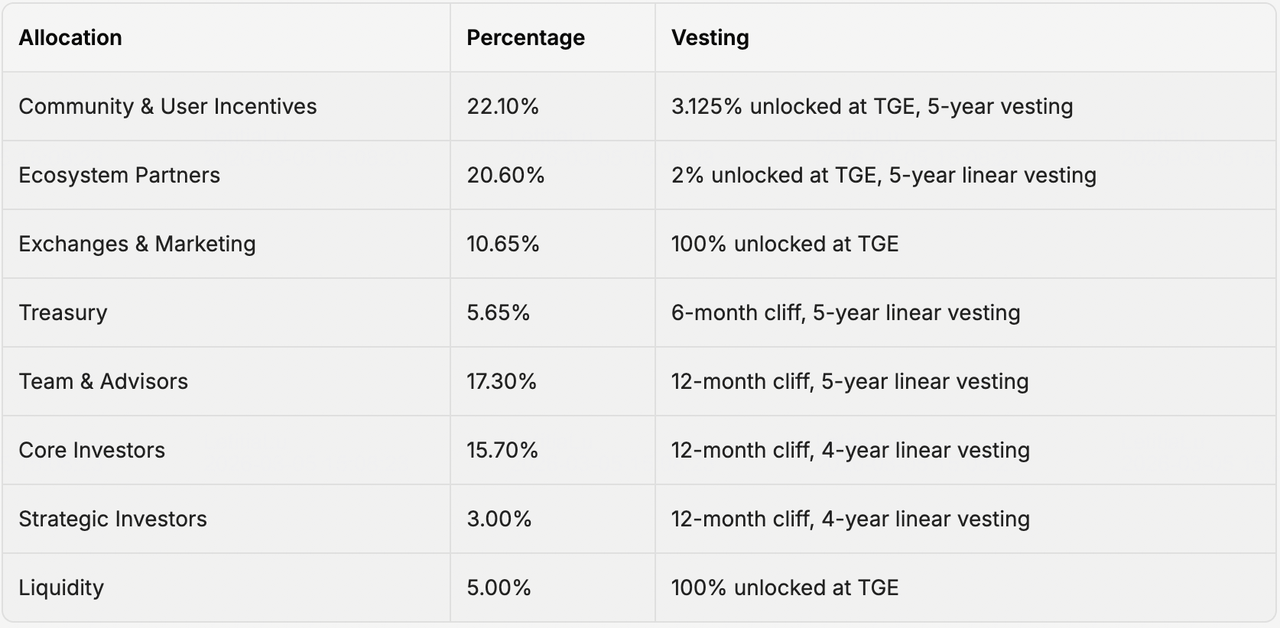
• Community and User Incentives (22.1%) : 3.125% unlocked at TGE, with the remainder vesting linearly over 5 years to reward early users and active participants.
• Ecosystem Partners (20.6%) : 2% unlocked at TGE, with the rest distributed over a 5-year vesting schedule to support integrations and partnerships.
• Team and Advisors (17.3%) : Subject to cliffs and multi-year vesting to align contributors with long-term protocol growth.
• Core Investors (15.7%) : Released through structured cliffs and linear vesting consistent with institutional investment terms.
• Exchanges and Marketing (10.65%) : Fully unlocked at TGE to support exchange listings and market expansion.
• Treasury (5.65%) : 6-month cliff followed by a 5-year vesting schedule for strategic development and operational funding.
• Liquidity (5%) : Fully unlocked at TGE to seed trading liquidity.
• Strategic Investors (3%) : Allocated under vesting terms similar to core investor allocations.
Block Street vs. Traditional On-Chain Liquidity: Key Differences
Traditional decentralized exchanges built on AMM models work well for crypto-native tokens but are less efficient for tokenized real-world assets (RWAs). Because AMMs rely on passive liquidity pools, assets with off-chain price anchors such as stocks or bonds can experience wider slippage and inefficient capital usage.
Block Street introduces a different model. Through Aqua’s RFQ execution system, liquidity is sourced from market makers, institutional desks, and on-chain pools in real time, enabling tighter spreads and better price discovery similar to traditional equity markets. Combined with Everst’s lending and leverage layer, tokenized assets can simultaneously function as trading instruments, collateral, and yield-generating positions.
|
Metric |
Standard DEX / AMM Model |
Block Street Infrastructure |
|
Liquidity Model |
Passive AMM Pools |
RFQ + Hybrid Liquidity (Aqua) |
|
Asset Coverage |
Crypto-Native Tokens |
Tokenized Equities, RWAs |
|
Execution Quality |
Fragmented, Slippage-Prone |
Best Execution, Tight Spreads |
|
Capital Reuse |
Liquidity Siloed by Pool |
Unified Cross-Issuer Pool |
|
Institutional Access |
Limited Infrastructure |
API Access, Institutional Integration |
|
Chain Support |
Single-Chain Native |
Multichain: Ethereum, BNB, Monad |
Block Street (BSB) Airdrop Set for March 4, 2026: How to Claim Your BSB
Before its Token Generation Event (TGE), Block Street ran a points farming campaign on its Monad testnet and BNB Chain environment at blockstreet.money. Participants earned points by interacting with the protocol’s ecosystem, helping test its infrastructure and liquidity mechanisms ahead of launch. These accumulated points convert directly into $BSB tokens at TGE.
Time: The $BSB airdrop claim window runs from March 4, 2026 (11:00 AM UTC) to May 4, 2026 (11:00 AM UTC). Eligible users must claim within this period or risk forfeiting their allocation.
Who’s Eligible for the $BSB Airdrop?
Users who participated in Block Street’s ecosystem campaign before TGE may qualify for the airdrop. Eligible activities include:
• Swapping assets through Aqua, the protocol’s RFQ execution engine
• Trading tokenized stocks on the Block Street platform
• Lending or borrowing assets via Everst
• Completing platform missions and referrals on the Block Street dashboard
• Participating in the Monad testnet or BNB Chain environment during the points campaign
How to Claim the BSB Token Airdrop: Step-by-Step Guide
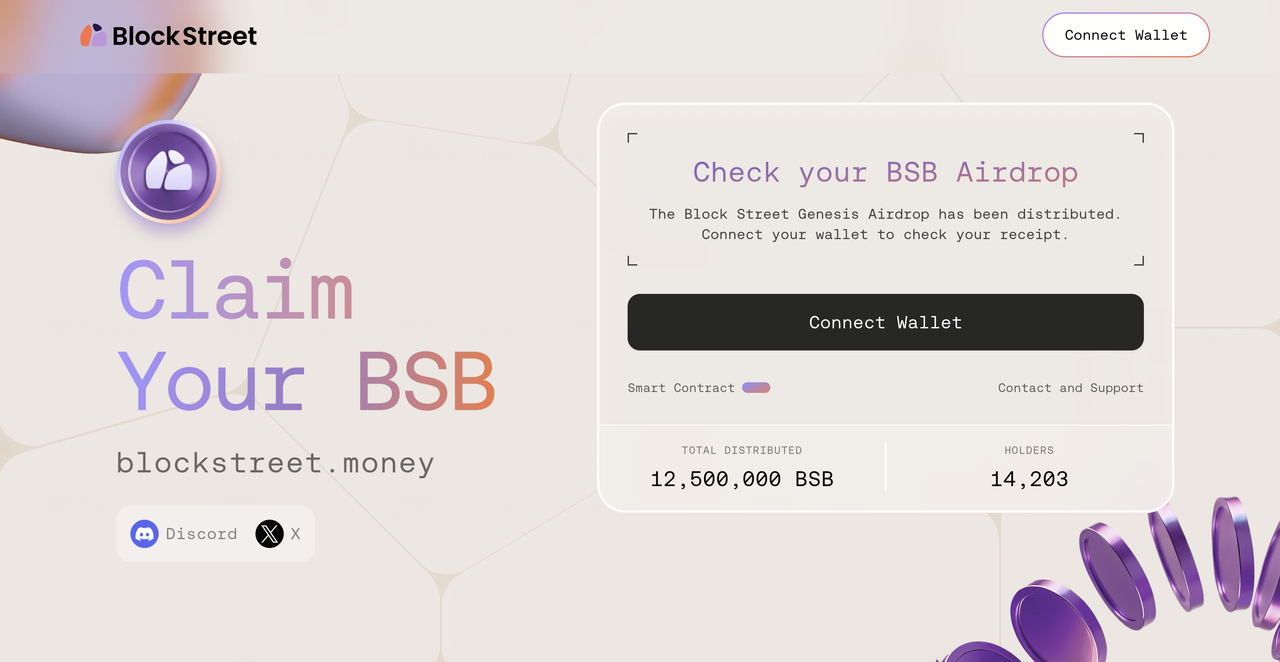
1. Connect Your Wallet: Visit BlockStreet Official Claim Portal and connect the wallet you used during the testnet campaign to check if it is eligible for the airdrop.
2. Check the Claim Window: Ensure you submit your claim within the active period (March 4 – May 4, 2026).
3. Confirm the Claim: Follow the on-screen instructions to approve the claim transaction. Make sure your wallet holds a small amount of ETH or BNB to cover gas fees.
4. Beware of Scams: Only use links from the official @BlockSt_HQ account or directly from blockstreet.money. Never share your private keys or seed phrase.
How to Trade Block Street (BSB) on BingX
Traders can use BingX AI to gain real-time market insights when trading $BSB, helping analyze momentum, sentiment, and volatility in fast-growing sectors such as tokenized equities and RWAs.
Long or Short BSB Perps in the Futures Market for Volatility
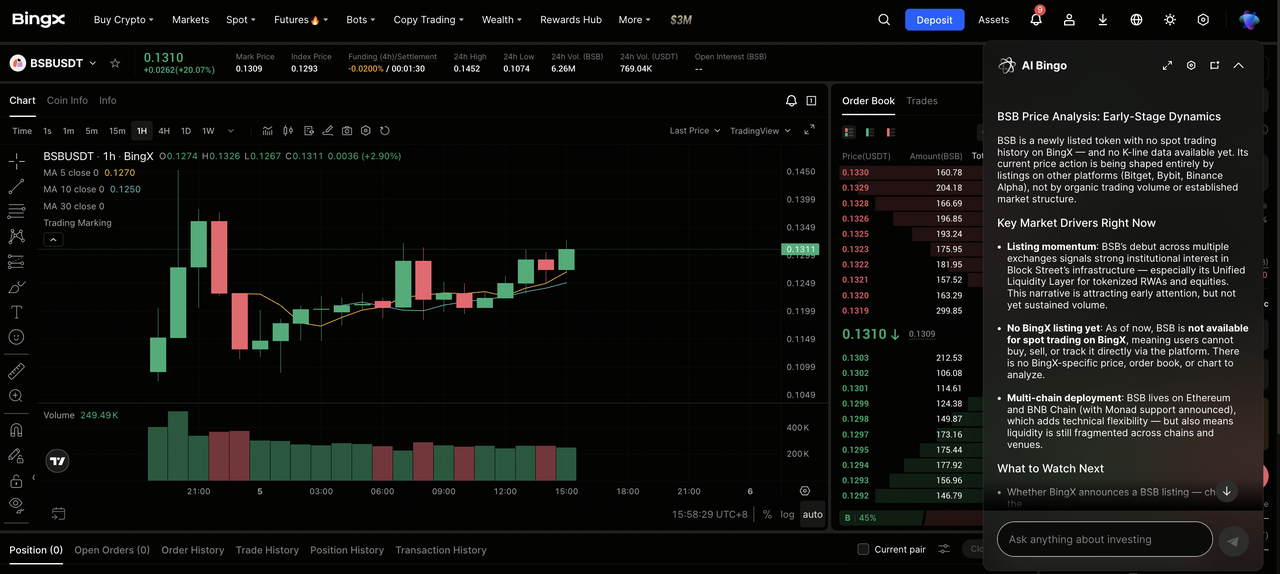
Traders seeking to capitalize on BSB's high-beta moves tied to the RWA narrative cycle, or to hedge against broader market pullbacks, can utilize perpetual contracts on BingX.
1. Transfer Margin: Move USDT into your Futures Account and search for the BSB/USDT perpetual contract.
2. Analyze Trends: Monitor RWA sector momentum and broader tokenized equity adoption metrics; BSB tends to amplify moves in the RWA narrative as institutional interest ebbs and flows.
3. Risk Management: Utilize Take-Profit/Stop-Loss orders to navigate multi-year vesting unlocks and potential supply absorption from early backers.
3 Key Considerations Before Trading BSB
Before trading $BSB, it is important to understand the structural factors that could influence adoption and token performance.
1. RWA Narrative Dependence: Block Street’s value is closely tied to the growth of the tokenized equities and RWA market. If institutional adoption of on-chain assets slows or regulatory clarity weakens, demand for the protocol’s liquidity infrastructure could be affected.
2. Vesting and Supply Unlocks: A large portion of BSB supply remained locked at TGE, with scheduled unlocks across team, investor, and ecosystem allocations over the coming years. Monitoring vesting cliffs and unlock schedules is important to anticipate potential selling pressure.
3. Protocol Usage Metrics: The long-term value of $BSB depends on real platform adoption. Key indicators include trading volume through Aqua, total value locked in Everst, and the number of tokenized assets integrated into the Unified Liquidity Layer.
Conclusion: Is Block Street (BSB) a Good Investment in 2026?
Block Street (BSB) represents a strategic bet on the growth of tokenized capital markets and real-world assets (RWAs). By focusing on the liquidity and execution infrastructure that many RWA protocols lack, Block Street introduces tools such as Aqua’s RFQ-based trading, Everst’s leverage and lending layer, and a Hybrid Liquidity Engine that connects institutional market makers with on-chain settlement. Combined with a team experienced in quantitative finance and distributed systems, the project aims to position itself as a foundational layer for tokenized equities and RWA trading.
That said, the investment outlook for BSB is closely tied to the broader adoption of tokenized assets. Regulatory developments, institutional participation, and competition from other RWA infrastructure platforms will all influence its long-term trajectory. As with any early-stage crypto infrastructure project, investors should evaluate protocol adoption metrics, token vesting schedules, and ecosystem growth before making an investment decision.
Related Reading
1. What Is Ondo Finance (ONDO), Bringing Tokenized RWAs and Real-Yields On-Chain?
2. How to Trade Crude Oil Using Crypto: A Complete Beginner’s Guide (2026)
3. How to Trade Commodities With Crypto in 2026 as Oil, Gold, Silver, and TradFi Go On-Chain
4. How to Trade Forex, Commodities, Stocks, and Indices With BingX TradFi: A Beginner’s Guide (2026)
FAQs About Block Street (BSB)
1. Which blockchain is Block Street built on?
$BSB is a multi-chain token issued as an ERC-20 on Ethereum and a BEP-20 on BNB Smart Chain. The Block Street protocol is designed to operate across multiple networks, including Ethereum, BNB Chain, and Monad, through its Unified Liquidity Layer.
2. Which wallets support BSB?
BSB can be stored in most EVM-compatible wallets, including MetaMask, Trust Wallet, and other wallets that support Ethereum and BNB Chain networks. Hardware wallets integrated with these wallets can also be used for additional security.
3. When is the Block Street (BSB) airdrop?
The official BSB airdrop claim window runs from March 4, 2026 (11:00 AM UTC) to May 4, 2026 (11:00 AM UTC).
4. Who is eligible for the BSB airdrop?
Users who participated in the Block Street points farming campaign before TGE may qualify. Points were earned through activities such as swapping assets via Aqua, trading tokenized stocks, lending or borrowing through Everst, and completing missions on the platform dashboard.