
Privacy remains one of the most critical yet underserved aspects of decentralized systems when it comes to blockchain technology. Public blockchains like Ethereum offer transparency and security through immutable ledgers, but this visibility often conflicts with the need for confidential transactions in real-world applications such as finance, identity, and asset management.
Aztec addresses this challenge as a pioneering privacy-first Layer 2 zkRollup solution built on Ethereum, enabling developers to create smart contracts with native, programmable privacy while benefiting from Ethereum's security and liquidity. Launched in its Ignition phase in November 2025, Aztec has achieved significant milestones, including over 90,000 blocks processed with zero downtime and a highly decentralized sequencer network boasting thousands of active participants worldwide.
This guide explores Aztec, a privacy-first Layer-2 zkRollup on Ethereum, explaining how its programmable zero-knowledge technology enables confidential transactions and private smart contracts, and how you can get started trading AZTEC on BingX.
What Is AZTEC Ethereum Layer-2 Network?
Aztec is a privacy-first Layer 2 zkRollup on Ethereum designed to bring confidential transactions and private state to smart contracts. Unlike standard Ethereum transactions that expose all details publicly, Aztec allows hybrid execution where private functions run client-side on the user's device and generate zero-knowledge proofs, while public functions execute transparently on the network. It uses a privacy-preserving virtual machine and is not EVM-compatible, instead introducing tools like the Noir domain-specific language to make privacy programmable and composable.
Transactions settle on Ethereum Layer 1 for final security, combining scalability, decentralization, and end-to-end privacy in a single hybrid architecture. Since its Ignition Chain launch in late 2025, the network has maintained perfect uptime, surpassed 90,610 blocks, and supports both public and private state in a unified system.
This innovative solution empowers developers to build secure, scalable applications with programmable privacy, enabling confidential transactions, private smart contracts, and hybrid public-private execution, all while inheriting Ethereum's robust security. Unlock end-to-end privacy for DeFi, identity, NFTs, and beyond with Aztec's groundbreaking zero-knowledge technology.
Who Created AZTEC zkRollup for Ethereum and When Did It Launch?
Aztec was founded in 2017-2018 by a team of experienced cryptographers and engineers, including Zac Williamson as CEO, Joe Andrews, Tom Pocock, and Arnaud Schenk. Williamson, with a background in particle physics and cryptography, led the vision for native privacy on Ethereum after recognizing the limitations of public blockchains for institutional and personal use cases. The project evolved from early experiments in private tokens and zk-money to a full Layer 2 network, attracting backing from prominent investors such as a16z crypto and Paradigm.
Over nearly a decade, the founders focused on building foundational tools like the Noir language to democratize zero-knowledge proof development and deliver a truly decentralized privacy solution. The project has raised significant funding, including over $100 million in equity rounds and approximately $60 million (19,000 ETH) through its community-driven token sale in December 2025.
What Are the Key Features of AZTEC Network?
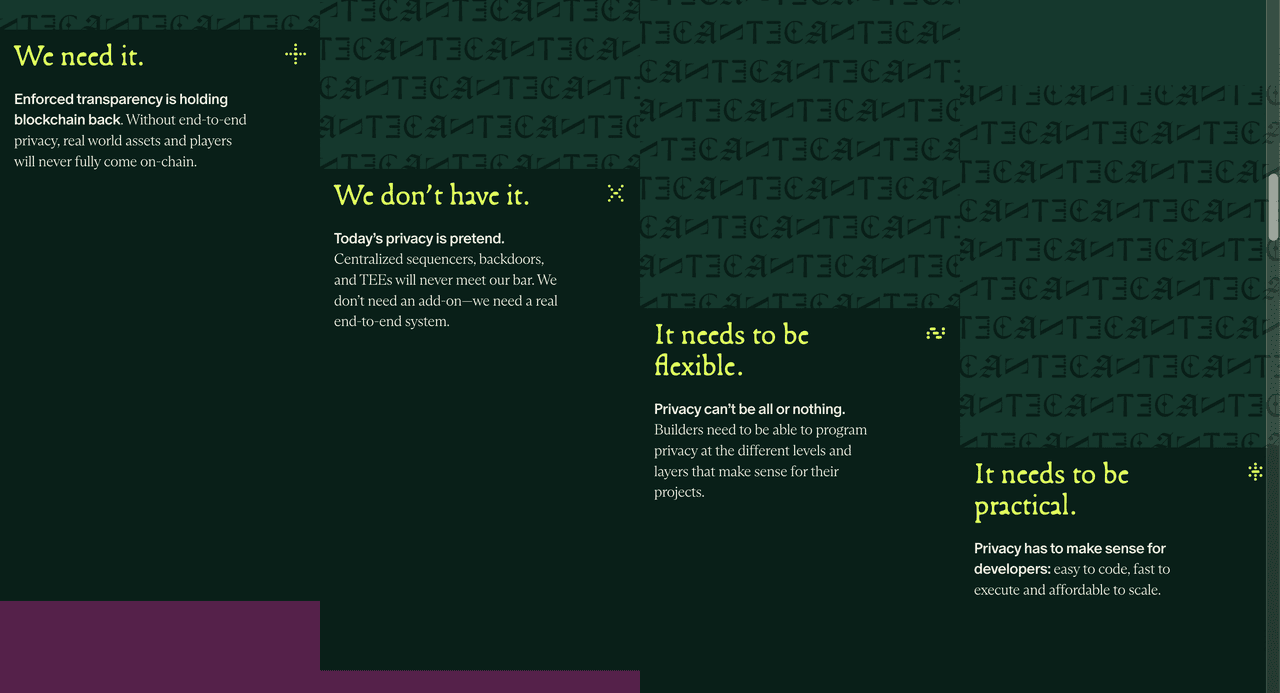
Aztec stands out through several innovative features that solve longstanding privacy limitations in blockchain. It offers programmable privacy, allowing developers to selectively encrypt data, metadata, transactions, or code using Noir, a Rust-like language for zero-knowledge applications. Client-side proofs keep sensitive information off-chain entirely, while composable privacy ensures seamless interactions across private and public states or even with other chains.
From day one, the network operates with full decentralization through a permissionless sequencer network and decentralized proving. Additional strengths include a hybrid state model using encrypted UTXOs for private data and account-based models for public data, making it practical, efficient, and affordable for building real-world applications like private DeFi, NFTs, and identity solutions. As of early 2026, the network boasts 185 operators across five continents and over 3,698 active sequencers, demonstrating robust global participation and decentralization.
What Is the AZTEC Token and Tokenomics?
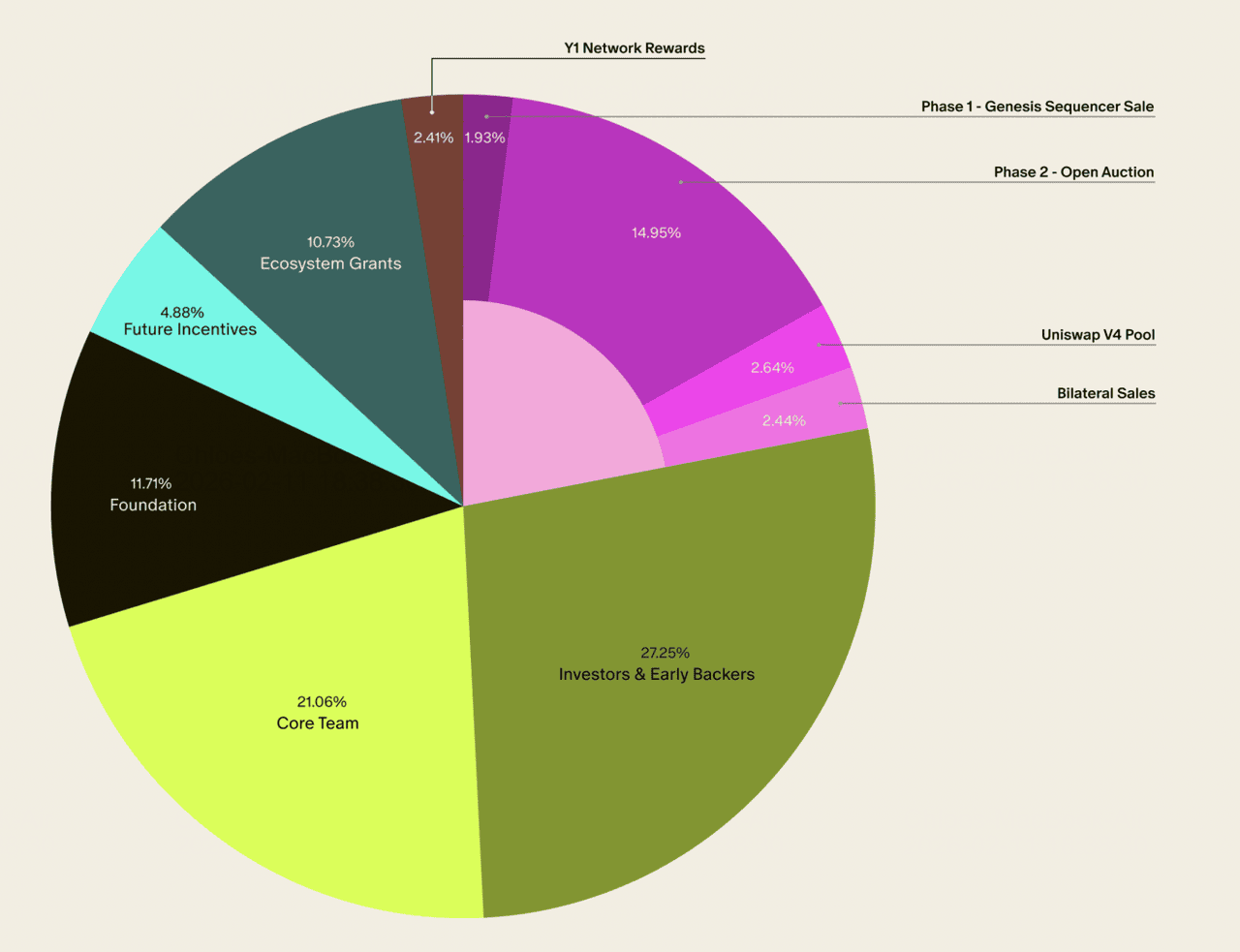
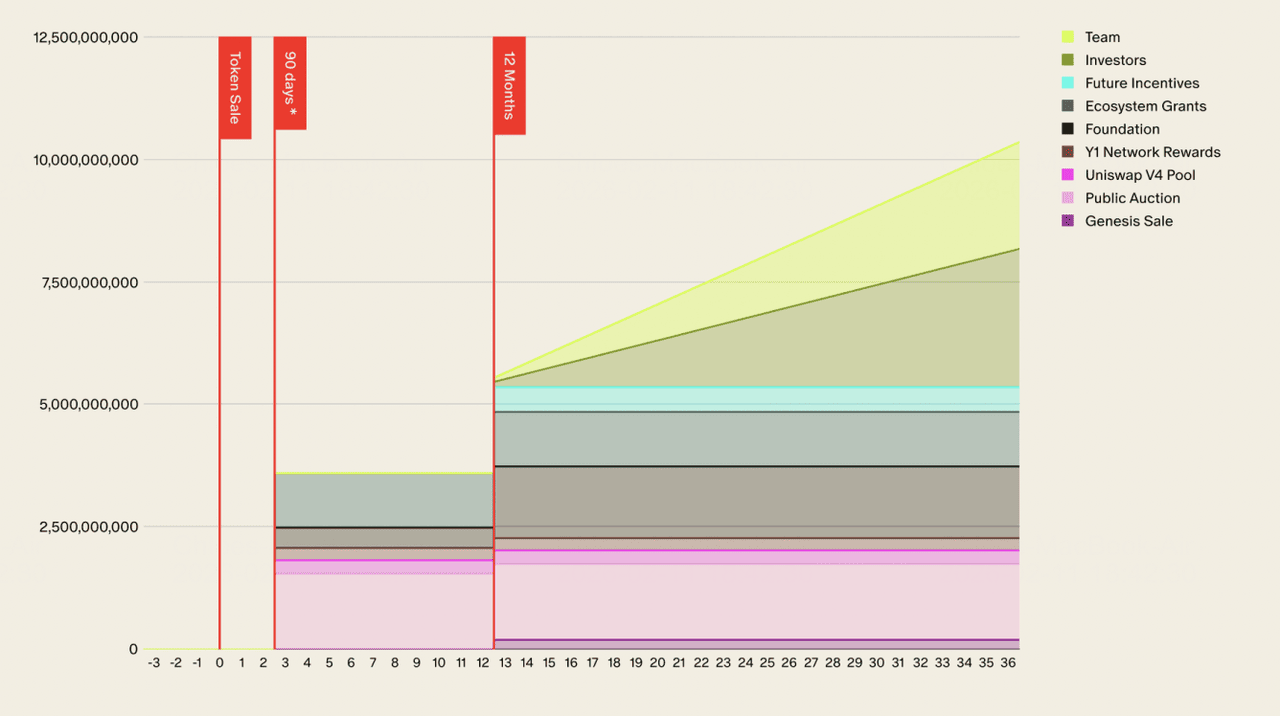
Source: AZTEC Docs
The native $AZTEC token powers the Aztec Network by enabling staking for sequencers and provers, governance participation, and potential future fee mechanisms. It has a total genesis supply of 10.35 billion tokens with a detailed allocation:
• 27.26% to investors and early supporters,
• 21.06% to the core team,
• 11.71% to the foundation,
• 10.73% to ecosystem grants,
• 14.95% to Phase 2 public auction,
• 1.93% to Phase 1 genesis sequencer sale,
• 2.44% to bilateral sales,
• 2.64% to Uniswap V4 liquidity pool,
• 4.89% to future incentives, and
• 2.41% to Year 1 network rewards.
Team and investor tokens are subject to vesting periods, typically one year lock followed by linear unlocks, to align incentives with long-term network growth. The token supports network security through staking requirements with a minimum of 200,000 $AZTEC for sequencers, with over 916 million AZTEC already staked as of early 2026, reflecting strong community engagement and an estimated APR of around 16.6% for participants.
When Did the AZTEC Token Launch?
The Aztec Token Generation Event (TGE) occurred on February 12, 2026, at approximately 7:00 AM UTC, following a successful on-chain governance vote by token sale participants and early stakers. This milestone made tokens from the public sale fully transferable, unlocked block rewards for trading, and injected liquidity into a Uniswap V4 AZTEC/ETH pool for price discovery, with an initial setup including 273 million AZTEC tokens and corresponding ETH.
The event transitioned the network toward broader utility, allowing anyone to acquire and use $AZTEC for staking, governance, and ecosystem participation while maintaining self-custody through personal token vaults during the pre-TGE phase. It represented a key milestone after years of development, a community-driven Continuous Clearing Auction that raised around $60 million (19,000 ETH) from over 16,700 participants, and the activation of economic incentives on the Ignition Chain.
How to Trade AZTEC on BingX Pre-Launch Futures: Step-By-Step Guide
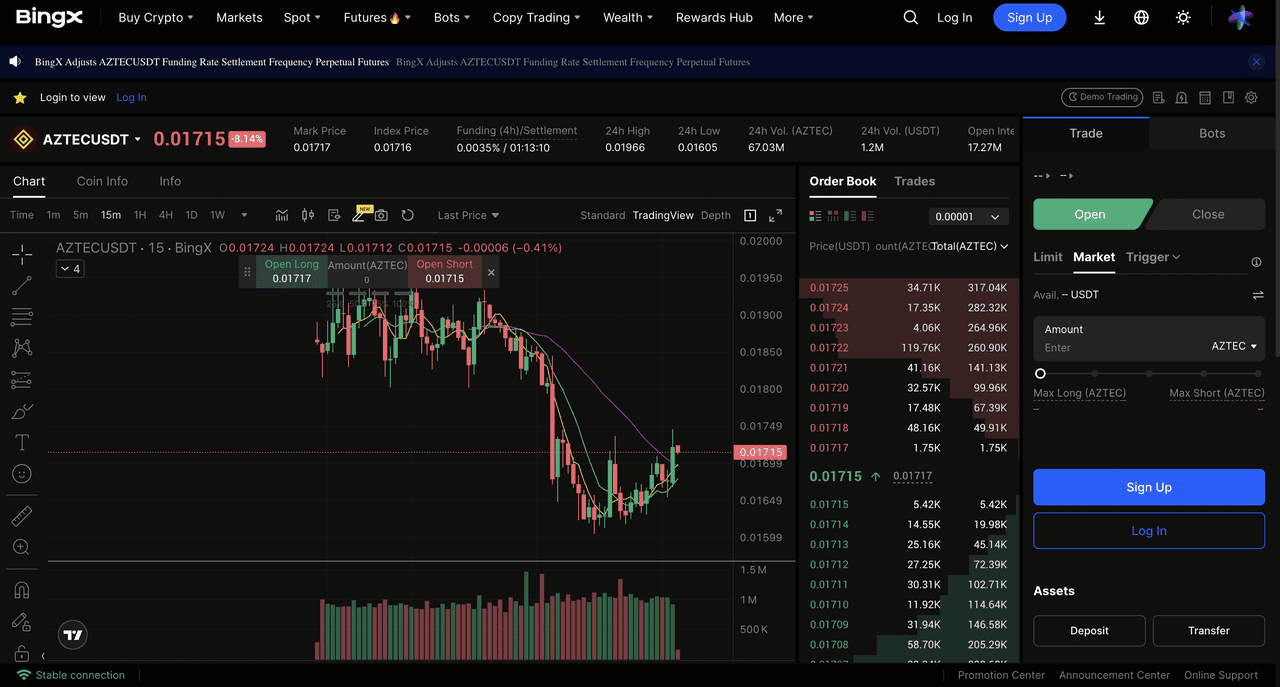
AZTEC/USDT on Pre-Launch BingX Futures
You can get a head start on trading long and short positions through the Pre-Launch Futures before the project officially goes live, enjoying up to 5× leverage.
Step 1: Log into your BingX account and ensure you have sufficient USDT in your futures wallet.
Step 2: Go to the Futures trading area and locate the Pre-Launch Futures section.
Step 3: Search for and select the AZTECUSDT perpetual contract.
Step 4: Choose long or short position, adjust leverage (up to 5x), set stop-loss or take-profit if desired, and input the trade size.
Step 5: Carefully review the details including funding rates and confirm the trade to open your position.
Conclusion: Should You Trade Aztec (AZTEC)?
Aztec represents a significant advancement in Ethereum's ecosystem by embedding programmable privacy at the protocol level, potentially unlocking widespread adoption of confidential DeFi, real-world assets (RWA), and privacy-preserving applications. With its TGE completed on February 12, 2026, the $AZTEC token now enables decentralized governance, staking security (with over 4,600 sequencers active), and rewards distribution, while the network's Ignition Chain has proven reliable with high block production and global operator diversity.
However, as with any emerging cryptocurrency, participants should conduct thorough research, understand the high volatility and risks associated with trading, and consider only what they can afford to lose. Staying informed through official Aztec channels will be essential as the network progresses toward full mainnet functionality and broader ecosystem growth.