
Unitas (UP) is a high-performance yield coordination protocol built on Solana and BSC, engineered to solve the dead capital problem in DeFi. While traditional stablecoins like USDC and USDT rely on centralized bank reserves and often provide zero native return to holders, Unitas provides a transparent, bank-independent alternative. By pairing spot crypto assets with offsetting short derivative positions, Unitas generates real, sustainable yield from market activity rather than inflationary emissions.
On March 20, 2026, Unitas hit a major milestone with the official launch of the UP token and the activation of its Global Savings Layer. Following a successful trading competition and a surge in USDu adoption, the protocol has surpassed $97 million in total supply. Backed by institutional-grade Off-Exchange Settlement (OES) via partners like Ceffu and Copper, Unitas is now the leading infrastructure play for market-neutral USD yields.
This article examines how Unitas's delta-neutral strategy protects capital, the mechanics of the sUSDu savings token, what the UP token launch means for protocol governance, and how to trade Unitas (UP) on BingX.
What Is Unitas (UP) Yield Infrastructure?
Unitas (UP) functions as a decentralized yield factory that converts volatile crypto collateral like SOL, ETH, BTC, into a stable, yield-generating dollar stack. It achieves this through Delta-Neutral Hedging: for every $1 of crypto collateral held, the protocol opens an equivalent $1 short position in the perpetual futures market. This cancels out price volatility (Delta = 0), ensuring the backing remains stable at $1 regardless of whether the market goes up or down.
The Unitas protocol generates an average historical yield of 8–15% APY by capturing three distinct revenue streams:
- Funding Rates: Payments made by long traders to short traders in bullish markets.
- Trading Fees: Revenue from liquidity provisioning in pools like Jupiter’s JLP.
- Protocol Fees: Small spreads from minting, redeeming, and liquidations.
By integrating Off-Exchange Settlement (OES), Unitas solves the exchange risk problem. Collateral stays in segregated cold storage with institutional custodians (Copper/Ceffu) while being mirrored to exchanges for trading. This provides the deep liquidity of centralized exchanges (CEXs) with the security of decentralized custody.
The protocol’s efficiency is reflected in its rapid scaling and consistent performance. As of late March 2026, the USDu supply has reached $97.86 million, supported by a robust 101.58% protocol backing ratio and a growing user base of over 181,000 participants. Practical backtesting and live data from the past year demonstrate the competitive edge of this model: while $100 invested in traditional stablecoins (USDT/USDC) remained stagnant and $100 in Treasuries grew to $101.19, the same amount in sUSDu appreciated to $111.87 over the same period. This represents an 11.87% absolute return, significantly outperforming Other Products' $104.01 growth by leveraging Solana's high-velocity trading activity.
How Does the Unitas Ecosystem Work?
The Unitas architecture is a modular stack designed to maintain a robust peg while maximizing capital efficiency:
- USDu (Synthetic Dollar): The base stable asset. It is over-collateralized (typically >102%) and kept stable through the delta-neutral engine. It acts as the medium of exchange within the ecosystem.
- sUSDu (Savings Token): The staked version of USDu. When users stake their USDu, they receive sUSDu, which acts as an appreciating receipt. The yield generated by the protocol is auto-compounded into the sUSDu contract, increasing its value relative to USDu over time.
- Strategy Layer: A basket of market-neutral strategies that deploy capital into high-yield venues like Solana’s JLP pool while maintaining a 1:1 hedge to remove directional risk.
- Safety & Insurance Layer: 10% of all protocol fees are diverted to an Insurance Fund, which acts as a buffer against rare tail-risk events or periods of sustained negative funding rates.
What Is the UP Token Used For?
The UP token is the primary coordination and governance asset for the Unitas protocol. Its utility includes:
- Governance Voting: UP holders propose and vote on risk parameters, new collateral types, e.g., LSTs (liquid staking tokens), and strategy integrations.
- Staking (sUP): Users can stake UP to receive sUP. Only sUP holders are eligible for protocol fee distributions once the Fee Switch is activated.
- Fee Switch Trigger: Unlike many protocols, UP does not distribute fees immediately. A Fee Switch can only be enabled via governance once the protocol hits three milestones: USDu supply > $1 billion, lifetime revenue > $100 million, and listing on 3 of the top 5 derivative exchanges.
- Ecosystem Incentives: UP is used to bootstrap liquidity and reward long-term participants who provide stability to the USDu peg.
What Is Unitas (UP) Tokenomics?
The $UP$ token features a hard-capped supply of 1,000,000,000 (1 billion). The distribution is heavily weighted toward the community to ensure decentralized growth.
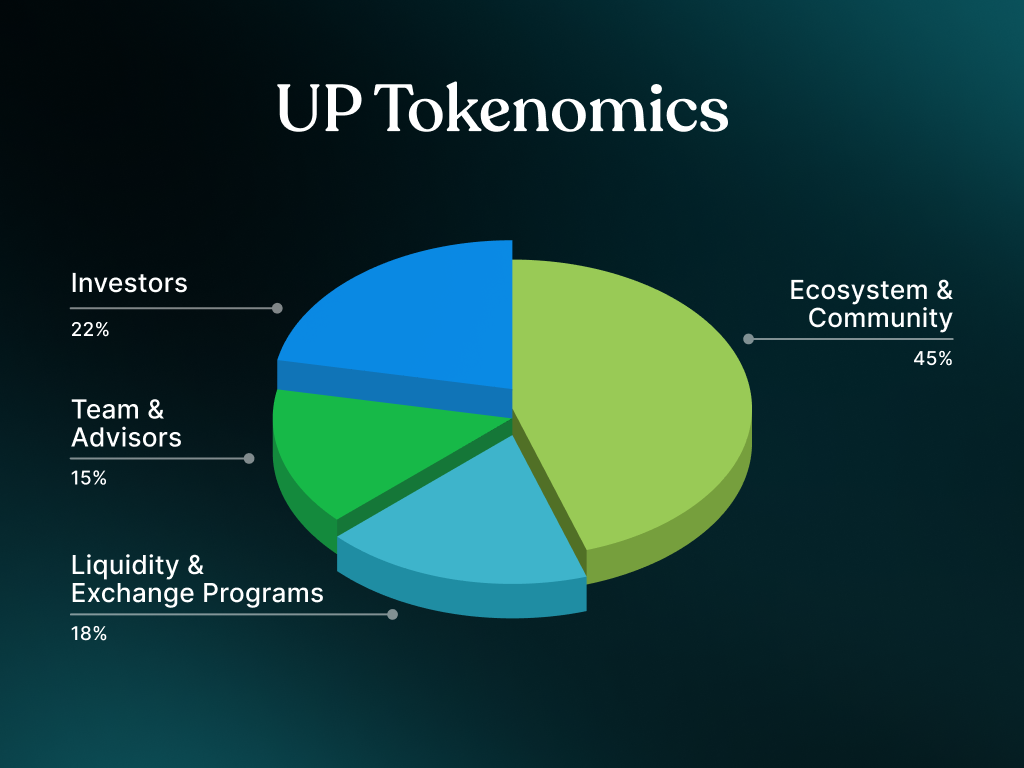
UP token allocation | Source: Unitas docs
UP Token Distribution and Vesting Schedule
- Ecosystem and Community (45%): The largest allocation, dedicated to contributor rewards, airdrops, and long-term ecosystem growth.
- Investors (22%): Allocated to strategic partners; these tokens are subject to a 12-month cliff followed by a 24-month linear vesting period.
- Liquidity & Exchange Programs (18%): Reserved for market making, providing exchange depth, and supporting global liquidity integrations.
- Team & Advisors (15%): Allocated to core developers and project guides; mirroring the investor schedule, these tokens feature a 12-month cliff and a 24-month linear unlock.
At TGE, the circulating supply was approximately 12.6%. With a strict 12-month cliff for the team and investors, there is significant structural stability in the token supply throughout the first year of operation.
How to Trade Unitas (UP) on BingX
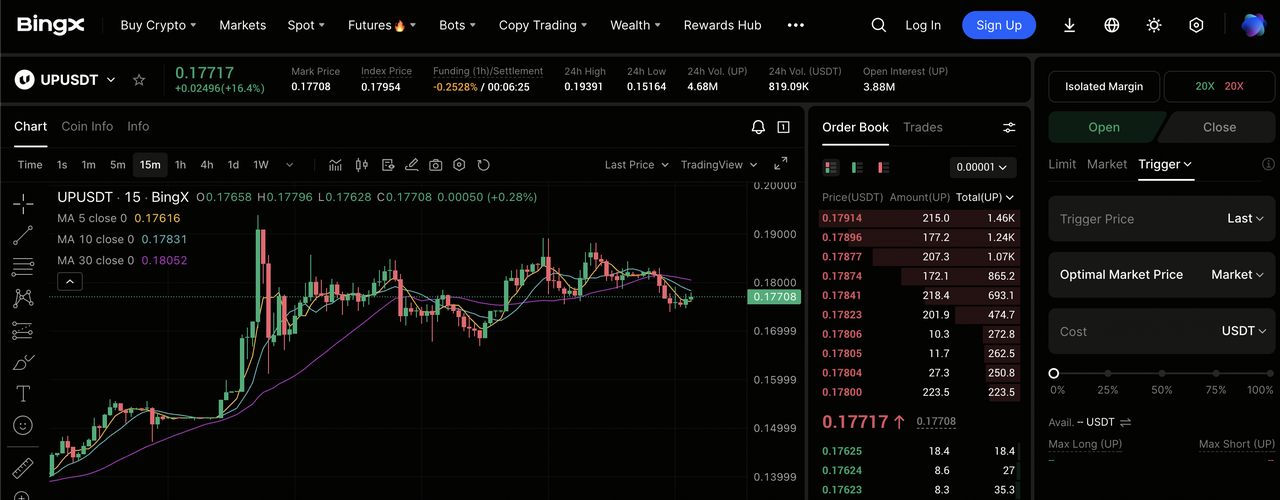
UP/USDT perpetuals on the BingX futures market
By integrating BingX AI-powered trend analysis, traders can now navigate the $UP$ token's market-neutral cycles with institutional-grade risk management and real-time momentum insights.
- Access the BingX Futures Trading Terminal: Log in to your BingX account, navigate to the Futures tab, and select Perpetual Futures. Search for the UP/USDT perpetual contract.
- Configure Your Margin: Choose between Isolated Margin to cap risk on a specific trade or Cross Margin to utilize your entire available balance for greater flexibility.
- Set Your Leverage: Select your desired leverage, e.g., up to 20x, to amplify your market exposure, keeping in mind that higher leverage significantly increases liquidation risk.
- Execute the Trade: Analyze the market using BingX’s technical tools; click Open Long if you anticipate the Global Savings Layer adoption will drive prices up, or Open Short to hedge against broader DeFi sector volatility.
- Monitor with AI: Utilize BingX AI to set precise Stop-Loss and Take-Profit levels, ensuring your capital is protected during 24/7 market fluctuations and funding rate shifts.
How to Stake USDu Stablecoin on Unitas for sUSDu Yield
Staking is the primary way for retail users to access Unitas's institutional-grade yield.
- Acquire USDu: Swap USDC or USDT for USDu on the Unitas App or via Jupiter on Solana.
- Stake: Navigate to the Earn tab and deposit USDu to mint sUSDu.
- Compounding: Your sUSDu balance stays the same, but its Redeemable Value in USDu increases every hour as yield is added to the pool.
- Unstake: Initiate an unstake request. There is a 7-day cooldown period to ensure protocol stability, after which you can withdraw your USDu.
Unitas USDu vs. Traditional Stablecoins: Key Differences
|
Feature |
Traditional Stablecoins (USDT/USDC) |
Unitas (USDu/sUSDu) |
|
Yield |
0% (Kept by Issuer) |
8–15% (Distributed to Users) |
|
Backing |
Bank Deposits/T-Bills |
Delta-Neutral Crypto Assets |
|
Transparency |
Monthly Attestations |
24/7 On-Chain Verifiable |
|
Custody |
Centralized Banks |
OES (Copper/Ceffu) + On-Chain |
Traditional stablecoins like USDC and USDT function as payment stablecoins, designed as inert settlement instruments. Their value is backed 1:1 by fiat-equivalent reserves (U.S. Treasuries and cash) held in centralized bank accounts. Crucially, the 5% risk-free yield generated by these reserves is retained entirely by the issuers like Circle and Tether, leaving holders with 0% native return. Furthermore, these assets remain tethered to the traditional banking system, exposing users to bank-run risks, as seen during the 2023 Silicon Valley Bank collapse which briefly depegged USDC to $0.88.
In contrast, Unitas USDu is a yield-bearing synthetic dollar that functions as a decentralized savings layer. Instead of bank deposits, it utilizes a delta-neutral strategy on the Solana and BSC blockchains, pairing crypto-collateral like SOL or JLP with offsetting short perpetual positions. This architecture targets a consistent 8–15% APY sourced from market funding rates and trading fees, yield that is passed directly to sUSDu holders. By using Off-Exchange Settlement (OES) with custodians like Copper and Ceffu, Unitas detaches from traditional banks, keeping assets in segregated cold storage while accessing the deep liquidity of centralized exchanges.
Read more: USDC vs. USDT: Key Differences and Which Stablecoin to Choose in 2026?
Unitas USDu vs. Ethena USDe Yield-Bearing Stablecoins
While both protocols utilize delta-neutral hedging to create synthetic dollars, they target different sectors of the crypto-derivative market. Ethena (USDe) primarily benchmarks its yield against ETH staking rewards of around 3–4% combined with funding rates from BTC and ETH perpetuals on major exchanges. In contrast, Unitas (USD/u) differentiates itself by tapping into the Solana ecosystem's liquidity, specifically utilizing the JLP (Jupiter Liquidity Provider) pool as a core collateral and yield engine. This allows Unitas to capture an additional layer of revenue from trader PnL and swap fees within Jupiter’s perpetual exchange, sources that are often more stable than the highly volatile funding rates that drive Ethena’s variable APY.
Practically, this means Unitas offers a unique uncorrelated yield profile: while Ethena’s returns may compress during sideways or slightly bearish funding droughts, Unitas continues to accrue value as long as there is high trading volume and volatility on Solana. However, with a market cap of nearly $6 billion as of March 2026, Ethena remains the deep-liquidity standard for institutional-grade DeFi savings, while Unitas with a market cap of around $22.5 million offers a higher-alpha opportunity for users looking to capitalize on the capital efficiency and explosive growth of the Solana DeFi stack.
Read more: What Is Ethena’s USDe Yield‑Bearing Stablecoin and How Does It Work?
5 Key Considerations Before Investing in Unitas (UP)
Before engaging with the UP token or sUSDu yields, investors should evaluate the unique technical, regulatory, and market-driven factors that define Unitas’s role as a decentralized savings infrastructure.
- Funding Rate Risk: In extreme bear markets, funding rates can turn negative. Unitas manages this via its Insurance Fund and delta-neutral rebalancing.
- Solana Scalability: As a Solana-native protocol, Unitas benefits from low fees but is subject to the network's overall uptime.
- The $1B Milestone: The UP token's Fee Switch requires significant protocol growth, making it a long-term play on USDu adoption.
- Counterparty Risk: While OES reduces exchange risk, the protocol still relies on the solvency of custodians like Copper and Ceffu.
- Smart Contract Security: Always verify that you are interacting with the official addresses listed in the Unitas Docs to avoid phishing.
Final Thoughts: Should You Invest in Unitas (UP)?
As of late March 2026, Unitas (UP) has transitioned from a specialized hedging protocol into a foundational execution layer for the broader yield-bearing stablecoin economy. By integrating an institutional-grade matching engine with decentralized on-chain transparency, the protocol provides a scalable alternative to traditional, zero-yield stablecoins. The practical value of the UP token is structurally tied to the protocol's ability to reach its $1 billion supply milestone, effectively shifting the passive dollar model toward an active savings infrastructure that captures real-world trading revenue.
For the strategic participant, Unitas serves as a primary case study for the delta-neutral thesis, where financial engineering is purpose-built to provide a bank-independent dollar. The platform’s ability to maintain its over-collateralization ratio and consistent yield distribution across Solana and BSC will be the ultimate metric of its sustainability. Success in this ecosystem requires a balanced approach: leveraging sUSDu for capital-efficient savings while remaining vigilant regarding the 12-month investor cliffs and the inherent volatility of derivatives funding rates.
Risk Reminder: Digital asset investments, particularly in emerging yield infrastructure protocols like Unitas, carry high market risk and price volatility. Yields are generated from market-neutral strategies and are not guaranteed; they may fluctuate or turn negative based on market conditions. Always perform your own research, utilize BingX AI for real-time risk assessment, and only trade capital you can afford to lose. BingX is not responsible for any trading losses incurred.