

Bitcoin market sentiment may be shifting as signs of renewed U.S. demand begin to appear. One key indicator closely watched by traders is the BTC Premium Index, which tracks the price difference between Coinbase and other major exchanges and often signals institutional activity.
The Coinbase Bitcoin Premium Index has turned positive again, reading +0.0028% as of March 3, and for traders watching institutional sentiment, this is exactly the kind of signal worth paying attention to. After 40 consecutive days in negative territory, U.S. market buying momentum is warming up, with three trading days in the past week registering a positive premium. This shift points to one clear development: institutional and compliant capital may be re-entering the market, and Bitcoin's next upside move could already be in motion.
What Is the Coinbase Bitcoin Premium Index?
The Coinbase Bitcoin Premium Index measures the percentage difference between Bitcoin’s price on Coinbase, a major regulated U.S. exchange, and the global average BTC price across leading international platforms.
Because Coinbase primarily serves U.S. retail investors, institutions, and compliance-focused capital, movements in this index act as a real-time indicator of U.S. market sentiment and institutional flows.
• Positive premium (Coinbase price above global average): Indicates stronger U.S. buying pressure and potential institutional inflows.
• Negative premium (Coinbase price below global average): Suggests stronger selling pressure from U.S. markets and weaker risk appetite.
This makes the Coinbase Premium Index one of the clearest market indicators for tracking whether institutional capital may be entering or exiting the Bitcoin market.
Coinbase Bitcoin Premium Index Turns Positive at +0.0028% After 40-Day Negative Streak
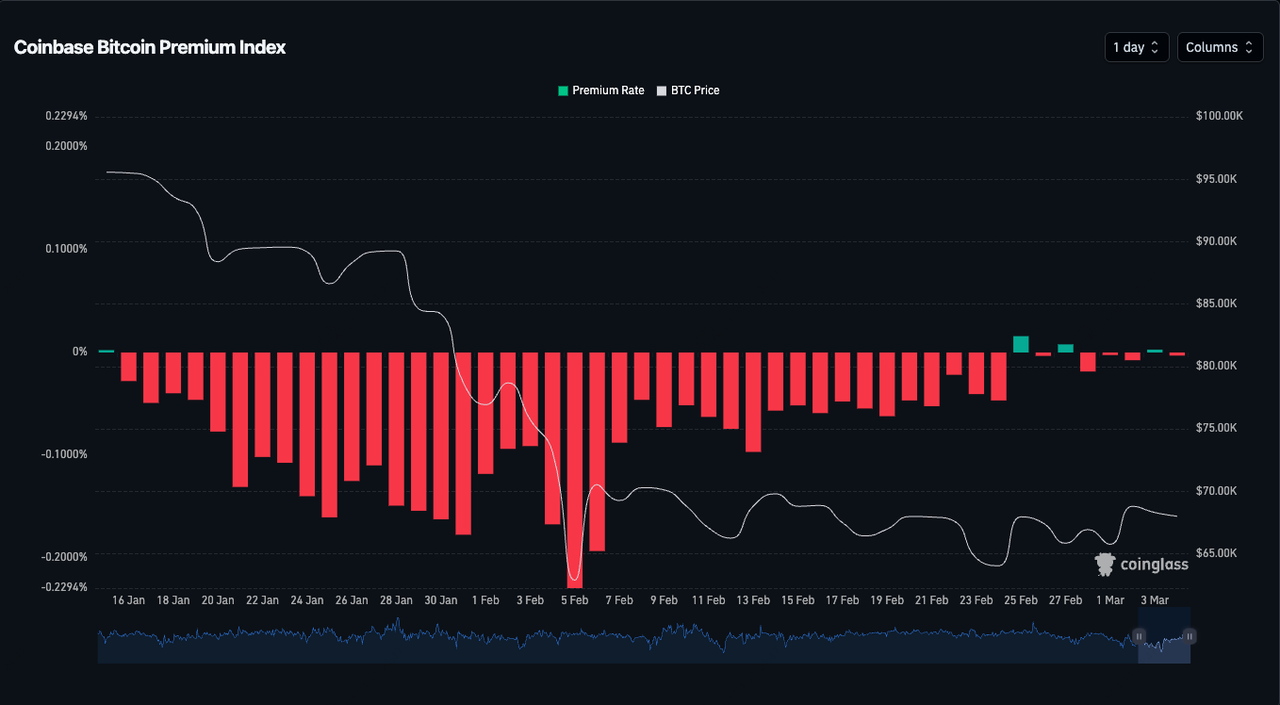
Image source: Coinglass
The Coinbase Bitcoin Premium Index has turned positive again, reading +0.0028% as of March 3, ending a 40-day stretch in negative territory. During that period, Bitcoin traded at a discount on Coinbase compared with global exchanges, reflecting weaker U.S. demand and cautious positioning from American market participants.
The return to positive premium suggests U.S. buying pressure may be recovering. The index recorded three positive trading days in the past week, indicating that demand on Coinbase is beginning to exceed global averages again. Because Coinbase is widely used by institutional and regulated investors, a positive premium often signals institutional capital returning to the market.
Historically, reversals from extended negative premiums have often been followed by stronger Bitcoin price momentum, particularly when macro conditions remain stable. While not a guaranteed signal, traders frequently track this shift as an early sign that institutional demand may be rebuilding.
What the Coinbase Bitcoin Premium Index Reversal Means for Bitcoin
A return to positive territory after a prolonged negative period represents a notable shift in market structure. Historically, when the Coinbase Bitcoin Premium Index flips positive after extended suppression, Bitcoin has often entered 4–8 weeks of upward price momentum, assuming macro conditions remain stable.
| Signal | What It Means |
| Premium turns positive after 40-day stretch | Strong reversal signal; U.S. buy-side returning after extended suppression |
| Three positive days in one week | Demand shift appears consistent rather than a one-off spike |
| Institutional-heavy platform driving premium | Higher-quality demand from regulated and institutional capital |
1. 40 Days of Negative Premium and Now a Clear Reversal: For 40 consecutive days, the Coinbase Bitcoin Premium Index remained negative, reflecting cautious U.S. positioning and reduced institutional participation. Extended suppression periods often act like a coiled spring. The longer the negative stretch lasts, the more meaningful the eventual reversal can be once the index turns positive.
2. Three Positive Days in One Week Signals Consistency: Over the past week, the index recorded three separate positive readings. A single positive day can be noise, but multiple positive prints within the same week suggest a genuine shift in U.S. buy-side demand rather than a temporary spike.
3. Institutional Capital Likely Behind the Move: Coinbase serves a large base of institutional and regulated investors, including hedge funds, ETF custodians, and professional trading desks. When Bitcoin trades at a premium on Coinbase relative to global exchanges, it typically indicates these participants are actively bidding for BTC on a compliant platform, creating a more durable form of demand than retail-driven momentum.
How Traders Are Interpreting the Positive Coinbase Bitcoin Premium Signal
Short-term outlook: With the premium index now positive after a prolonged negative stretch, the near-term setup for Bitcoin is becoming more constructive. Improving U.S. dollar liquidity conditions and recovering risk appetite add further support. If the positive premium holds or expands over the coming days, traders may view the current environment as an opportunity to establish or add to BTC positions.
What to watch: The key continuation signal is whether the Coinbase Bitcoin Premium Index remains above zero. If the premium continues to build and is confirmed by indicators such as funding rates, exchange netflows, and spot ETF inflows, the probability of sustained upside strengthens. A quick return to negative premium would suggest the move was temporary rather than the start of renewed institutional demand.
How to Trade Bitcoin Perpetual Futures on BingX
Bitcoin can be traded on BingX through the BTC/USDT perpetual futures market, allowing traders to take both long and short positions depending on market conditions. Unlike traditional futures, perpetual contracts do not have an expiration date, making them suitable for traders who want to actively trade Bitcoin price movements.
BingX AI also provides real-time market analysis and trend indicators to help traders evaluate momentum and manage volatility.
Steps to Trade BTC Perpetual Futures
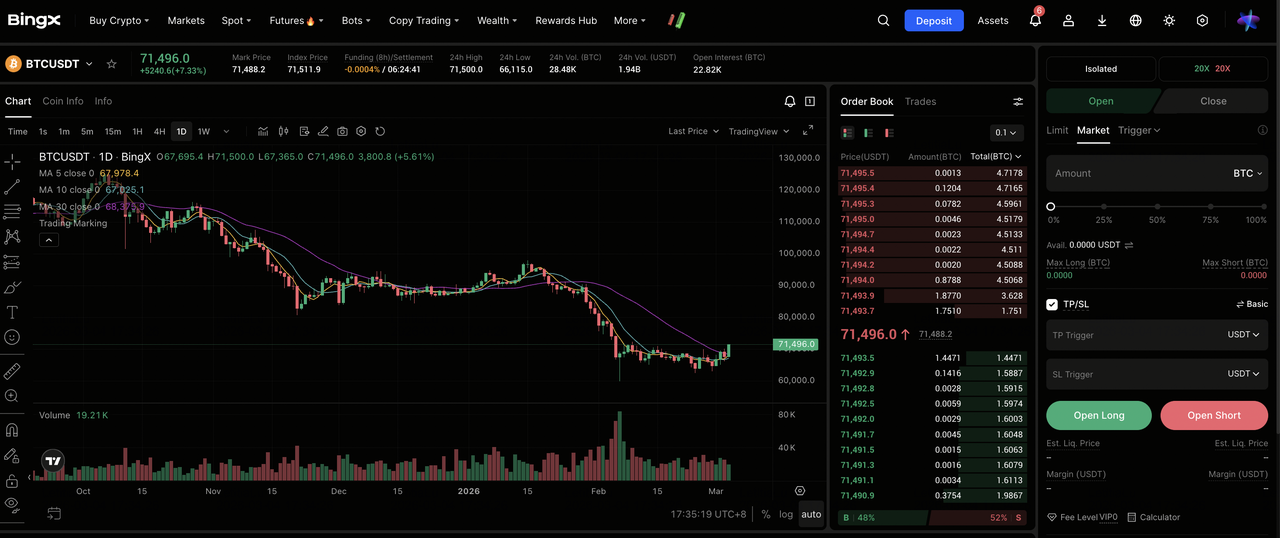
1. Open the BTC/USDT Perpetual Futures market: Log in to your BingX account and navigate to the BTC/USDT Perpetual Futures trading page.
2. Choose your position direction: Select Long if you expect Bitcoin’s price to rise, or Short if you expect the price to decline.
3. Set order type and position size: Choose a market order for immediate execution or a limit order to enter at a specific price. Then specify the position size and leverage level.
4. Manage risk before opening the trade: Set stop-loss and take-profit levels to control downside risk and lock in gains if the market moves in your favor.
5. Monitor the position using BingX AI insights: Track market momentum, RSI divergence, and volatility signals with BingX AI tools to adjust your position if conditions change.
Leverage can amplify potential returns but also increases risk, so careful position sizing and risk management are essential when trading Bitcoin perpetual futures.
Final Thoughts
The recent shift in the Coinbase Bitcoin Premium Index to positive territory suggests that buying sentiment in the U.S. market is starting to recover. For traders and investors watching short-term market signals, a positive premium often indicates that demand may be strengthening and that Bitcoin could have room to move higher.
This change does not guarantee a sustained rally, but it is a signal worth paying attention to. Investors may consider monitoring the premium closely and evaluating potential entry opportunities as market momentum develops.
As always, market conditions can change quickly. Investors should remain cautious and make trading decisions based on their own risk tolerance and strategy.