
If you have spent even a few minutes in a cryptocurrency community, you have likely encountered the acronym BTD - "Buy the Dip." While it sounds like a simple catchphrase, it is actually a foundational trading philosophy used to navigate market cycles. At its core, buying the dip is the practice of purchasing a digital asset after its price has experienced a temporary decline.
Why Do Crypto Traders Love the Dip in Market?
Imagine your favorite store suddenly announces a 20% off sale on an item you’ve wanted for months. You’d probably rush to buy it. In the world of crypto, a "dip" is that sale. Traders love dips because they allow you to get more "bang for your buck."
By entering at a lower price point, you lower your average cost basis, which significantly increases your potential profit margin when the market eventually recovers.
The Reality Check: Volatility vs. Value
However, the crypto market isn't a retail store, and price drops aren't always "sales." This is where the reality of market volatility kicks in. A price drop can be a minor correction in a healthy uptrend, or it could be the beginning of a long-term crash.
The Golden Rule: Not every drop is a dip; some are the start of a downtrend.
Successful BingX traders distinguish themselves by knowing the difference. Buying a "dip" in a dying project is like trying to catch a falling knife; you’re more likely to get hurt than to make a profit. To buy the dip effectively, you must ensure the asset's long-term value remains intact despite the short-term price "noise."
Why Most Crypto Traders Fail to 'Buy the Dip': Trading Pyschology
Buying the dip sounds easy in theory, but in practice, it is a psychological battle. When prices are crashing, and your social media feed is filled with "doom and gloom," the natural human instinct is to protect what you have and sell, not buy more.
Fear vs. Opportunity
The most successful traders on BingX often follow the famous mantra: "Be fearful when others are greedy, and greedy when others are fearful." When a dip occurs, the market is driven by fear. This fear often causes "weak hands" to sell their assets at a loss. For a disciplined trader, this mass exit creates an opportunity.
However, if you haven't mastered your emotions, you might find yourself paralyzed by "Analysis Paralysis," waiting for the price to drop "just a little bit lower" until you miss the bounce entirely.
Top Technical Tools to Spot Your Entry When Buying the Dip in Crypto
To move from a casual trader to a strategic investor, you need to replace "gut feelings" with objective data. On the BingX trading interface, several powerful technical analysis tools can help you pinpoint exactly when a dip has reached its bottom.
1. How to Use Historical Support Levels to Spot Your Entry
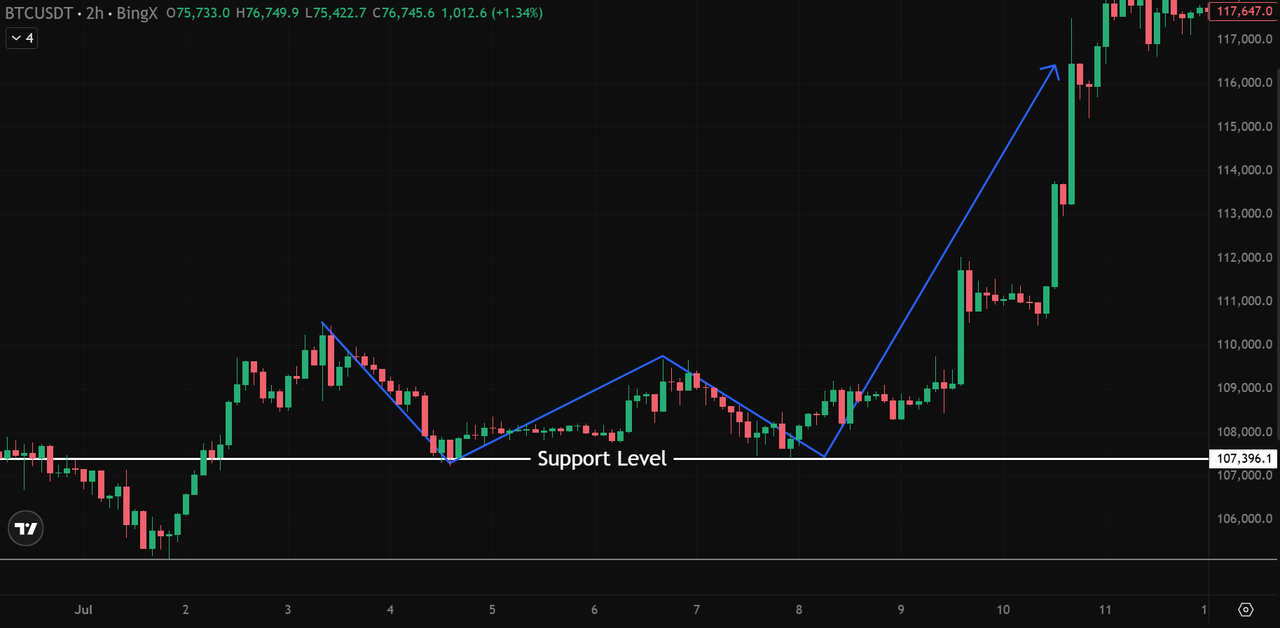
The most fundamental tool for any dip-buyer is the Support Level. Think of support as a "price floor" where an asset has historically struggled to fall below. When cryptocurrency enters a dip, it will often gravitate toward these previous areas of high demand.
Source: BTC/USDT Trading Chart on BingX
As seen in the attached BTC/USDT chart, the price established a clear support floor at approximately $107,396. Notice how the price dipped multiple times toward this white horizontal line (the "Support Level") but failed to break through it.
Each time it touched this zone, buyers entered the market, creating a "bounce" that eventually led to a massive upward rally toward the $117,000 range.
How to Trade This on BingX
By looking at your BingX charts on a Daily (1D), 4-hour (4H), or even 2-hour timeframe, you can identify these floors by looking for:
• Price Clusters: Areas where candles "sit" on a specific horizontal line without closing below it.
• Previous Lows: Points where the asset bounced in the recent past, indicating strong buy-side liquidity.
2. How to Measure Momentum Using the RSI
The Relative Strength Index (RSI) is a momentum oscillator (scaled 0 to 100) used to identify when a dip has become "over-extended".
Source: BTC/USDT Trading Chart on BingX
Identifying the Oversold Zone
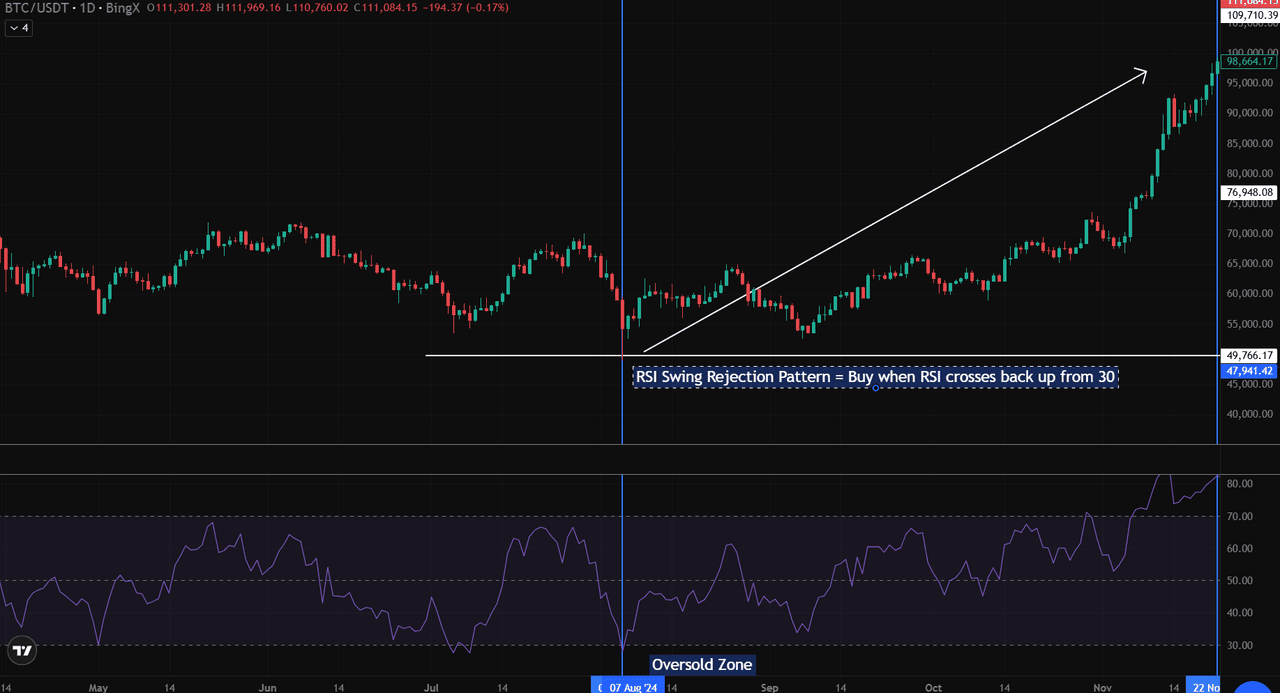
In the BingX Learn community, the magic number to watch is 30. When the RSI drops below this level, the asset is considered "Oversold." This suggests that the intense selling pressure has likely exhausted itself, and a relief rally or a full trend reversal is imminent.
Analyzing the Chart: The RSI Swing Rejection
As illustrated in the attached BTC/USDT Daily (1D) chart, the RSI provides a high-probability "Buy the Dip" signal through the Swing Rejection Pattern. Look closely at the vertical blue line:
• The Oversold Trigger: The RSI plummeted into the Oversold Zone (below 30), coinciding with a major price bottom near $49,766.
• The Buy Signal: The ultimate signal occurs when the RSI crosses back up from 30. This confirms that bullish momentum is returning to the market.
• The Result: Following this RSI crossover, the chart shows a massive sustained rally (indicated by the white arrow), taking the price from the $50,000 range all the way toward new highs near $100,000.
Professional BTD Tactic
Buying when the RSI is in the 20–30 range is a classic tactic used by professional swing traders on BingX. However, for the safest entry, wait for that upward crossover back above the 30 line. This ensures you aren't just buying a falling asset, but rather entering as the "momentum" shifts back in your favor.
3. How to Use Moving Averages as Dynamic Support on BingX
Unlike static horizontal lines, Moving Averages (MA) act as a "live" support system that adjusts with market momentum. These indicators are essential for "Buy the Dip" strategies as they reveal where institutional buyers typically defend an asset.
Identifying the 50-Day MA "Buy Zone"
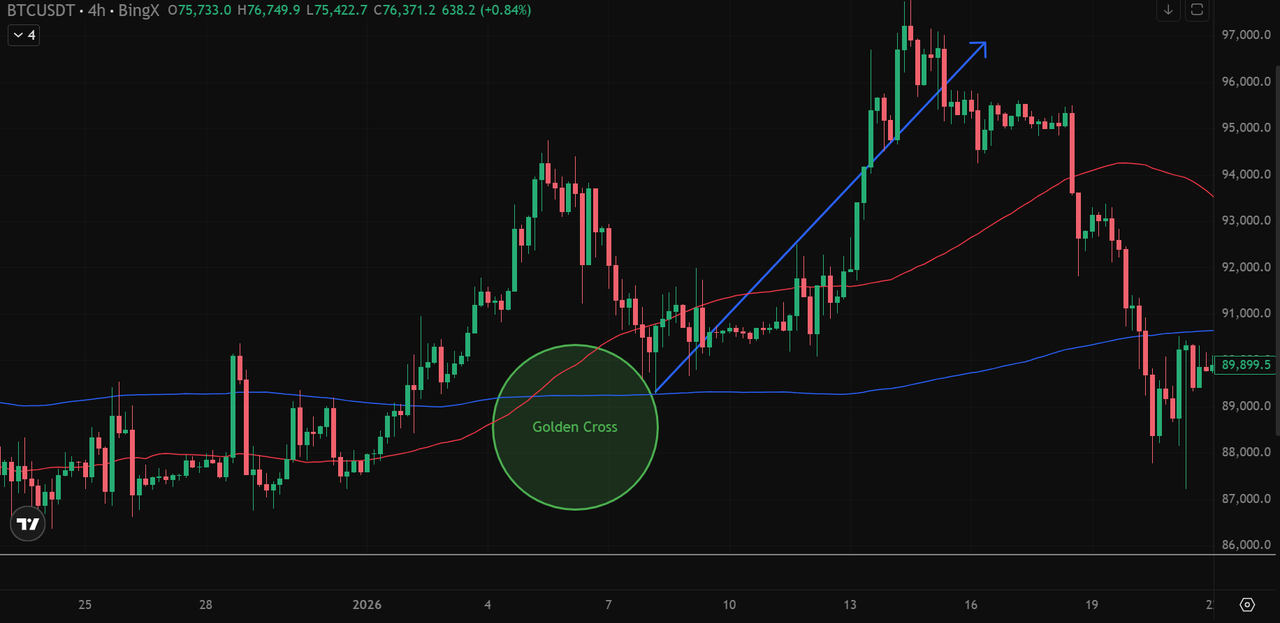
The 50-day MA (red line) is the primary tool for mid-term trends. In a bull market, prices often "dip" to touch this line before resuming an upward move. On your BTC/USDT 4h chart, the red line trails the price, acting as a high-probability entry zone during pullbacks.
Source: BTC/USDT Trading Chart on BingX
The Golden Cross Launchpad
The most significant signal is the Golden Cross, where the 50 MA crosses above the 200-day MA (blue line). On your chart, this occurred near $90,000, serving as a launchpad for the rally toward $97,000. The blue line near $89,000 remains the ultimate macro floor; as long as Bitcoin stays above it, the long-term bullish outlook is intact.
Read more: Golden Cross vs Death Cross in Crypto Trading: Spotting Market Shifts with Moving Averages
What are the Best Trading Strategies for Buying Crypto Dips?
Execution is often where traders struggle most. Even with the right indicators, your entry method determines your risk-to-reward ratio. On BingX, you can use these three battle-tested strategies to remove emotion from your trading and avoid the "falling knife" trap.
Strategy A: The Ladder Approach or Tiered Entry
One of the most common mistakes is trying to pick the "perfect" bottom. The Ladder Approach solves this by breaking your entry into multiple parts. Instead of going "all-in" at a single price, you place a series of Buy Limit orders at descending intervals.
For example, if Bitcoin is at $100,000, your "ladder" might look like this:
• Order 1: 20% of capital at a -5% drop.
• Order 2: 30% of capital at a -10% drop.
• Order 3: 50% of capital at a -15% drop.
By layering your orders, you ensure that if the dip goes deeper than expected, your average entry price becomes lower. This significantly reduces the psychological stress of watching a price drop after your first buy.
Strategy B: Automated DCA via BingX Spot Grid Bot
If you cannot monitor charts 24/7, Automated Dollar-Cost Averaging (DCA) is your best solution. While traditional DCA buys at set time intervals, the BingX Spot Grid Bot optimizes this by buying during dips and selling during minor bounces within a predefined range.
When you deploy a Grid Bot during a dip, it automatically places buy orders as the price falls and sell orders as it recovers. This allows you to accumulate assets during "sideways" volatility or gradual dipping without needing to manually time the market. It is a "set it and forget it" strategy that turns market volatility into an accumulation tool.
Strategy C: The Confirmation Buy for Conservative Entry
For conservative traders, the Confirmation Buy is the safest way to "Buy the Dip." Instead of catching the asset while it is still falling, you wait for the market to prove that the bottom is actually in.
You should look for two specific signals:
1. Green Candle Confirmation: Wait for a strong bullish candle to close on a higher timeframe (like 4H or Daily) after a series of red candles.
2. The RSI Crossover: Wait for the RSI to dip below 30 (Oversold) and then cross back above the 30 line.
This crossover confirms that downward momentum has shifted back to the upside. While you might miss the absolute bottom by 2-3%, you gain the security of knowing you aren't buying into a continuous crash.
Is it a Dip or a Market Crash? How to Tell the Difference
Successful trading on BingX requires more than just looking at a red candle on a screen; it requires context. Identifying a profitable dip means looking past the immediate price action to understand the fundamental "why" behind the decline.
In crypto, not all price drops are created equal; some are golden opportunities, while others are warning signs to stay away.
1. How to Identify Healthy Dips
A "healthy" dip is a natural part of a functioning market, often occurring during an established bull run. These pullbacks act like a "reset button," clearing out over-leveraged positions and allowing the market to build a stronger foundation for the next leg up.
Profit-taking Cycles: When an asset rallies, early investors lock in gains. This mass selling creates a temporary supply that softens prices, a sign of a maturing trend, not a failing one.
Short-Term Market FUD: Minor news events involving regulatory rumors or macro data often don't change a coin's core utility. These represent a "discount" on a solid asset.
Cascading Liquidations: A "long squeeze" forces over-leveraged traders out, causing a sharp drop that often recovers just as fast.
2. Trend Reversals: The Danger Zone
A dip becomes a disaster when the underlying trend changes from bullish to bearish. Watch out for:
Broken Fundamentals: Major security breaches, team departures, or regulatory bans.
Lower Highs and Lower Lows: If the price bounces but fails to reach its previous peak, the trend has shifted.
High Volume on the Drop: If the price is falling on massive trading volume, it indicates that "smart money" is exiting the building.
What Are the Common Pitfalls to Avoid When Buying the Crypto Dip?
Buying the crypto dip can be effective, but only when you avoid common mistakes and apply strict risk controls:
• Avoid “catching a falling knife”: A sharp drop does not guarantee a bottom; assets that fall 50% can still fall significantly further without confirmation of price stabilization.
• Don’t FOMO into the first red candle: Early entries on small pullbacks often lead to losses if the move develops into a deeper correction.
• Use stop-loss orders without exception: Placing a stop-loss just below key support or a recent swing low protects you from small losses turning into catastrophic drawdowns.
• Control position size: Risk no more than 1–2% of your total trading capital per trade to ensure multiple failed dip attempts don’t wipe out your account.
• Be cautious with leverage: Beginners should stick to spot trading to avoid liquidation, while experienced traders should keep leverage low of around 2x–5x to withstand volatility.
• Avoid high leverage during dips: Using 20x or higher leverage in volatile markets can lead to liquidation from even minor price movements, regardless of longer-term direction.
How to Manage Risk and Avoid Liquidation When Trading Dips in Crypto
The difference between a successful "Buy the Dip" investor and a liquidated account is a solid risk management plan. In crypto, a 10% dip can rapidly turn into a 30% crash; without protection, you aren't trading, you're gambling.
1. Why Is Stop-Loss Non-Negotiable?
A Stop-Loss is your essential insurance policy. It automatically sells your position at a pre-set level to prevent a small loss from becoming a catastrophic one.
Placement: Position your stop-loss just below the recent "Swing Low" or major support floor.
Validation: If the price breaks this level, your "dip" thesis is invalidated, and it’s time to exit.
Golden Rule: It is always better to take a 5% loss today than a 50% loss tomorrow.
2. How to Use Smart Position Sizing
Many traders make the mistake of going "all-in" on a single dip, hoping for a massive win. This is a recipe for disaster. Professional risk management suggests risking no more than 1–2% of your total account capital on any single trade.
For example, if your total trading balance is $10,000, a 2% risk means you should only lose a maximum of $200 if your stop-loss is hit. By managing your position size, you ensure that even a string of unsuccessful dip-buys won't wipe out your portfolio, giving you the "staying power" to wait for the next big market move.
3. Leverage Warning: How to Respect Volatility
While BingX offers powerful leverage options, using high leverage during a dip is extremely dangerous. When markets are volatile, "wicks" (sudden price spikes or drops) can trigger liquidations even if the price eventually goes in your direction.
For Beginners: Stick to Spot Trading. You own the asset, and you cannot be liquidated, no matter how low the price goes.
For Intermediate Traders: Keep leverage low, typically between 2x and 5x. This gives you a wider "liquidation price" and more breathing room to survive market swings.
High leverage (20x, 50x, or 100x) should be avoided when buying the dip, as even a minor 2% move against you can result in a total loss of your margin.
Conclusion: Discipline Over Emotion
Buying the dip is one of the most rewarding strategies in cryptocurrency trading, but it requires a blend of technical skill and emotional discipline. By identifying healthy corrections, using tools like RSI and Moving Averages, and strictly following risk management rules, you can turn market volatility into your greatest advantage. Success doesn't come from catching every single bottom; it comes from having a plan before the red candles appear.
Ready to build your dip-buying strategy? Explore the BingX Market or try Demo Trading to practice your entries risk-free.
Related Reading
FAQs on Buying the Crypto Dip
1. What is the difference between a "dip" and a "crash"?
A dip is a temporary price decline within an overall healthy uptrend, often caused by short-term profit-taking or minor news. A crash or trend reversal occurs when the underlying fundamentals of an asset break, leading to a long-term bearish shift characterized by lower highs and lower lows.
2. When is the best time to buy the dip?
The safest time to enter is when you see confluence, multiple technical signals lining up at once. For example, look for the price to hit a historical support level while the RSI crosses back above the 30 "Oversold" line.
3. How do I avoid "catching a falling knife"?
Avoid buying into a massive, rapid price drop without signs of stabilization. Instead of catching the asset while it is still falling, use the Confirmation Buy strategy: wait for a strong green candle to close on a 4H or Daily timeframe to prove that buyers have stepped back in.
4. What is a "Golden Cross" and why does it matter?
A Golden Cross occurs when a short-term moving average (50-day MA) crosses above a long-term moving average (200-day MA). This signal confirms a powerful shift into a bullish trend, making any subsequent dips toward these moving averages high-probability buying opportunities.
5. How much leverage should I use when buying a dip?
During periods of high volatility, leverage can be extremely dangerous due to price "wicks" that trigger liquidations. Beginners should stick to Spot Trading (0x leverage), while intermediate traders should keep leverage low, typically between 2x and 5x, to provide enough breathing room for market swings.
6. How do I protect my portfolio if the dip goes deeper?
Always use a non-negotiable Stop-Loss placed just below the recent swing low or major support level. Additionally, practice Smart Position Sizing by risking no more than 1–2% of your total capital on a single trade to ensure you have the "staying power" for future opportunities.