CESS Network (CESS) is a decentralized Layer-1 blockchain that merges scalable cloud storage with privacy-preserving AI infrastructure, offering fast, secure, and programmable data services for Web3 and enterprise use cases.
As data becomes the backbone of both AI innovation and digital sovereignty, centralized storage solutions are reaching their limits. This raises concerns around privacy, performance, and control. CESS introduces a trustless alternative: a globally distributed, incentive-aligned infrastructure where users maintain ownership of their data, developers build freely, and AI models train on encrypted datasets without exposing sensitive information.
In this article, we break down what CESS Network is, how it works, the utility and structure of the $CESS token, how to participate in its major airdrop campaign, and what’s ahead as the project prepares for its Token Generation Event (TGE), possibly launching in July 2025.
What Is CESS Network?
Source: CESS official Site
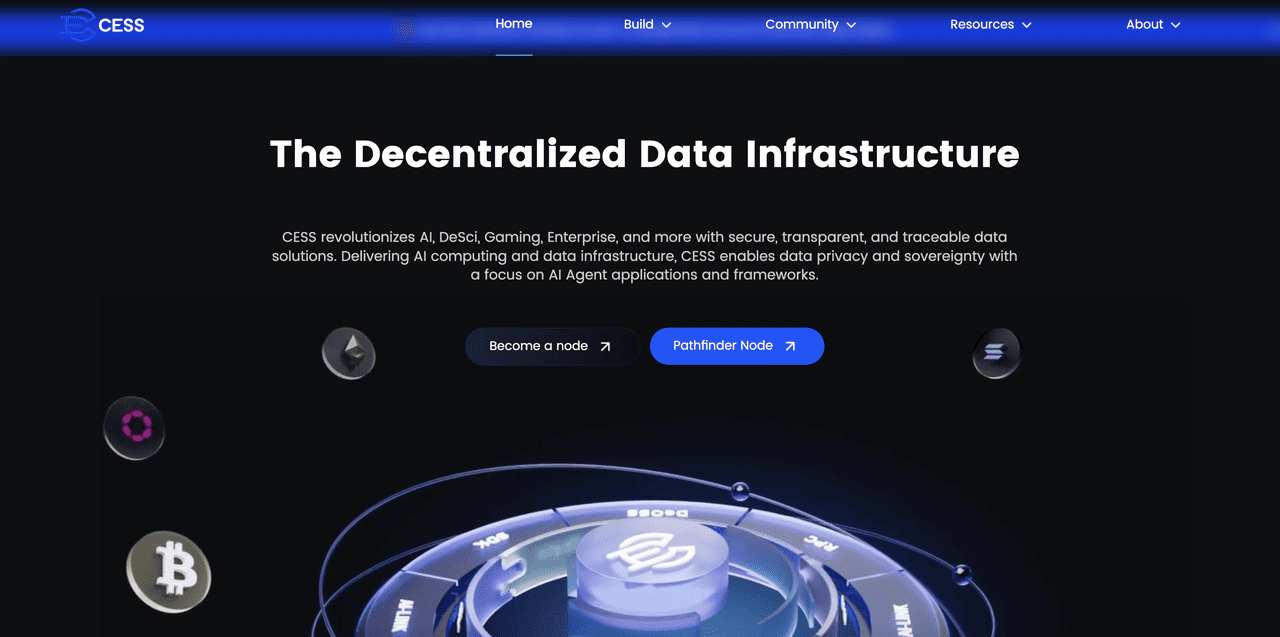
CESS (Collaborative Edge Storage Service) is the first decentralized data infrastructure built on its own Layer-1 blockchain, purpose-designed for high-frequency, large-scale, and privacy-sensitive data storage.
At its core, CESS combines blockchain-powered distributed storage with a native Content Decentralized Delivery Network (CD²N), enabling users and developers to store, share, and monetize data directly on-chain. Its architecture is optimized for AI, gaming, enterprise, and government use cases that demand low-latency access, compliance-aware storage, and secure data ownership.
With features like proxy re-encryption, disaster recovery, and support for smart contracts, CESS offers a Web3-native alternative to centralized cloud services. It enables trustless collaboration, protects digital rights, and scales horizontally to meet global data demands. Whether you're a dApp developer, enterprise, or contributor, CESS provides the infrastructure to build and operate in a decentralized data economy.
Although it does not explicitly label itself as a DePIN project, CESS shares many of the same characteristics. It relies on a permissionless network of hardware contributors who provide real-world storage and bandwidth resources in exchange for token rewards. This alignment makes CESS part of the broader movement toward decentralized physical infrastructure, especially in sectors like AI and cloud-native data services.

How Does CESS Work?
CESS is a decentralized infrastructure that separates blockchain, storage, and content delivery into modular layers. It encrypts data, splits it into fragments, and distributes it across a global network of nodes. When data is retrieved, it is securely reassembled on the user's device, ensuring that no single node or centralized entity ever holds full access.
The system is powered by two core protocol suites: the CESS Protocol Suite, which handles storage and delivery, and the XESS AI Protocol Suite, which enables secure, privacy-preserving AI collaboration. Together, they support real-time performance, encrypted sharing, and programmable infrastructure across Web3 use cases.
Source: CESS official Site
Key Features of CESS Network
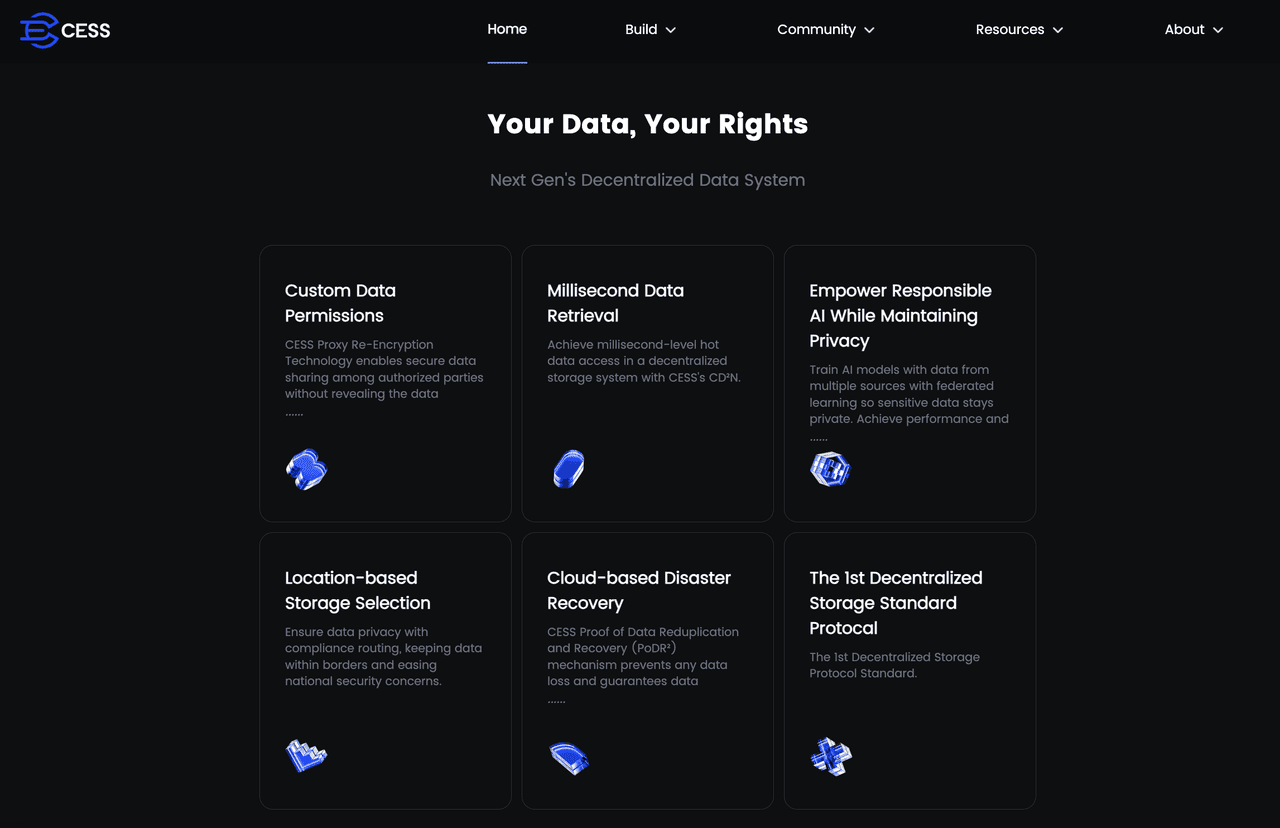
• Fast Data Access: Millisecond-level retrieval through the native Content Decentralized Delivery Network (CD²N), optimized for real-time applications.
• Strong Privacy Protection: End-to-end encryption with proxy re-encryption and trusted hardware environments that ensure only authorized users can access data.
• Disaster Recovery with PoDR²: Proof of Data Reduplication and Recovery (PoDR²) ensures data is always available. Files are stored with multiple encrypted copies across different nodes, and nodes are continuously challenged to prove they are storing valid data. If some nodes go offline, CESS can recover the full file from remaining fragments.
• Verified Node Contributions: Proof of Idle Space (PoIS) confirms that storage providers are actually contributing available capacity to the network.
• Elastic Storage Pool: CESS automatically aggregates and allocates global storage resources, creating a decentralized system that behaves like cloud storage.
• Location-Aware Storage: Users can select where data is stored, making it easier to meet jurisdictional or organizational requirements.
What’s $CESS Tokenomics?
$CESS is the native token that powers the CESS Network. It is used for payments, staking, rewards, and governance. The token is designed to support long-term sustainability and incentivize honest participation across all layers of the network.
CESS Token Supply and Distribution
 Source: CESS Whitepaper
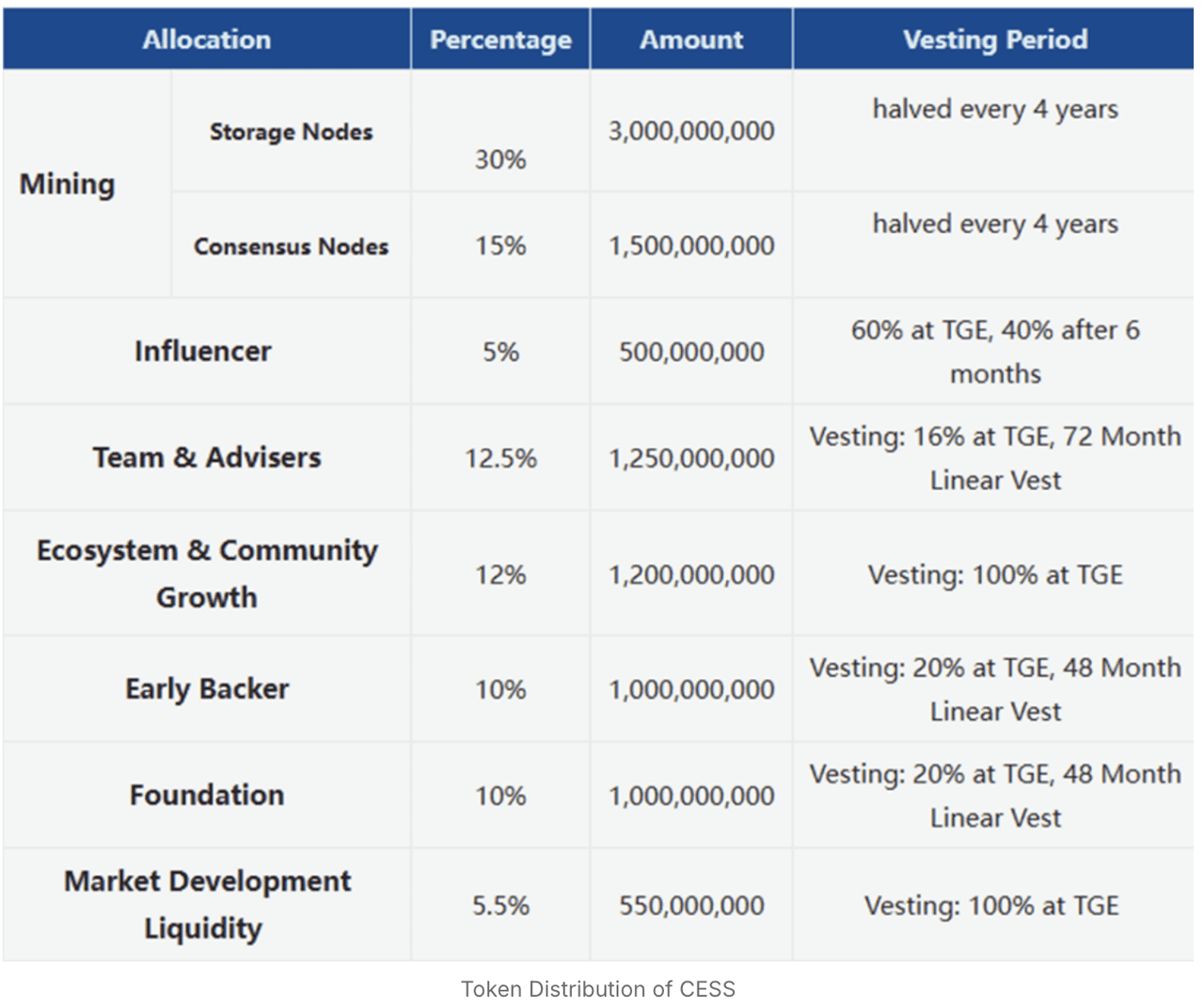
The total supply of $CESS is fixed at 10 billion tokens. At mainnet launch, 3.5 billion tokens will be created in the Genesis block. The remaining 6.5 billion will be released gradually through block rewards. Token issuance follows a halving cycle every four years, with an annual decay rate of 15.9% starting in year two. After 30 years, the issuance stabilizes at a fixed rate. Before mainnet, $CESS is issued on BNB Chain as a BEP20 token and will later be swappable to the native CESS token via a cross-chain bridge.
$CESS Token Utility and Use Cases
CESS is used as the primary medium of exchange within the network. Users pay for storage space, bandwidth, and content delivery services using CESS. The token is also essential for participating in the network’s consensus and storage layers.
• Storage nodes must stake 2,000 $CESS per terabyte (TiB) of declared capacity.
• Consensus nodes must stake a minimum of 3 million $CESS to become validators.
Staking ensures economic alignment and network security. Misbehavior results in slashing, where a portion of the staked tokens is deducted. Some of these tokens, along with transaction fees, are burned to help reduce circulating supply.
Governance and Incentives
As the network transitions toward full decentralization, $CESS holders will be able to participate in governance. Token holders can propose and vote on upgrades, parameter changes, and funding proposals through the upcoming CESS DAO.
In addition, node operators and contributors earn $CESS as rewards. These rewards are based on performance metrics such as uptime, validated storage, and bandwidth contribution. The system is designed to encourage long-term participation and discourage manipulation.
When Is the $CESS Airdrop: Key Dates
CESS is currently running two separate airdrop campaigns as part of its final pre-launch reward cycle. Each has its own dashboard, eligibility rules, and distribution timeline.
1. DeShare Airdrop (Snapshot-Based)
 Source: CESS DeShare Airdrop Dashboard
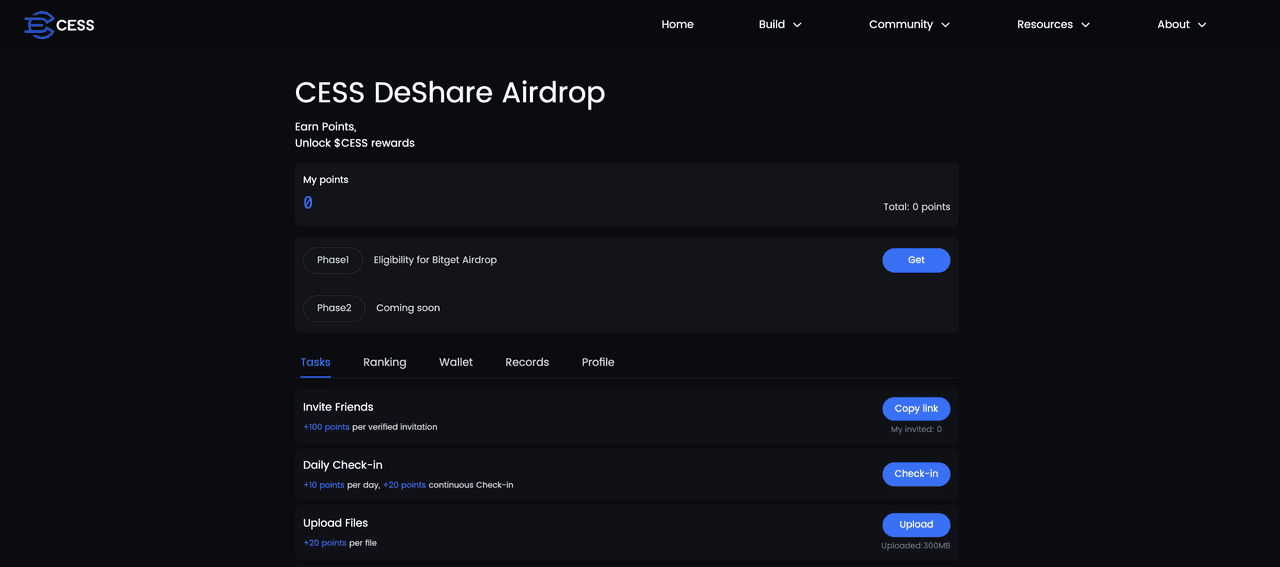
This airdrop rewards early users who tested the DeShare file-sharing app and completed basic engagement tasks before the snapshot. While participation is now closed, eligible wallets will be able to claim $CESS after the token launch. If your address was filtered out, you can submit a Real User Appeal Form to request manual review.
• Snapshot taken: June 20, 2025 at 00:00 UTC
• Status: Closed to new participants
• Token claim: Will follow the Token Generation Event (TGE)
• Dashboard: CESS DeShare Airdrop Dashboard
2. Interstellar Expedition Airdrop (Points-Based and Ongoing)

This is the final opportunity to earn $CESS through active participation. Users can complete tasks across five categories, including social media actions, creative content, file uploads, on-chain testing, and a knowledge quiz. All activity is tracked via a dedicated campaign dashboard, and points will be converted into tokens at the end.
Although no official end date has been announced, the community on X expects the campaign to conclude in late July 2025. Once it ends, CESS will announce the point-to-token conversion ratio and release claiming instructions. Users holding pre-mainnet BEP20 tokens will also be able to bridge to the native chain.
• Campaign start: June 20, 2025
• Expected end: Late July 2025
• Dashboard: CESS Interstellar Dashboard
When Is the CESS Network TGE?
The Token Generation Event is expected to take place shortly after the Interstellar Expedition ends. While the exact date has not been confirmed by the team, contributors like EmberCN suggest it will happen in late July or early August 2025.
How to Claim $CESS Token Airdrop and Prepare for the 2025 July TGE
The Interstellar Expedition is CESS's final airdrop campaign before its upcoming Token Generation Event (TGE). Participants can still earn CESS Points through tasks that span social engagement, creative contributions, product testing, and on-chain activity. These points will be redeemable for $CESS tokens once the campaign concludes.

There are five ways to participate:
1. Social Engagement: Follow CESS on X and TikTok, join the official Discord and Telegram, retweet campaign posts, and check in daily.
2. Community Contributions: Share original memes, GIFs, or videos that promote CESS. Be sure to tag @CESS_Storage and use #CESSNetworkPublicTest.
3. File Uploading via DeShare: Upload files using DeShare, CESS’s no-login file-sharing app. You’ll also earn bonus points for inviting verified friends.
4. On-Chain Interactions: Claim test tokens via Bitget Wallet and complete EVM signature tasks.
5. Knowledge Challenge: Take the “What is CESS?” quiz and update your profile for additional points.
Progress is tracked in real time via the CESS Airdrop Dashboard.
The campaign is expected to end in late July 2025. Although there’s no official statement confirming the exact date, the community on X widely expects the campaign to conclude around that time. After it ends, CESS will announce the point-to-token conversion ratio and provide official claiming instructions. Token distribution will follow the TGE, and pre-mainnet BEP20 holders will be able to bridge their tokens to the native chain.
If you were excluded by Sybil filters but are a real participant, you can submit a Real User Appeal Form for review.
What’s Next for $CESS: Roadmap and Ecosystem
With the airdrop campaign concluding and the TGE expected soon, CESS is entering a new phase focused on real-world deployment, developer growth, and decentralized governance.
Upcoming Protocol Upgrades
In the second half of 2025, CESS will roll out two major features. Secure Data Access will introduce proxy re-encryption combined with trusted execution environments (TEE), enabling encrypted and permission-controlled data sharing. CESS AI-LINK will allow organizations to train AI models collaboratively by exchanging encrypted parameters, without exposing raw data.
Looking ahead to 2026, the network plans to launch IPFS compatibility, expanding interoperability across decentralized ecosystems. Another key feature will be Multi-format Data Rights Confirmation (MDRC), which enables users to verify content ownership on-chain using metadata fingerprints.
Ecosystem Expansion and DAO Transition
The core product stack will continue evolving around DeOSS, a decentralized object storage platform for developers, and DeShare, a no-login file-sharing app designed for public use. Both products are positioned to drive adoption after mainnet launch.
Following the TGE, governance will gradually shift to the community through the introduction of the CESS DAO. Token holders will be able to propose and vote on protocol upgrades, incentives, and ecosystem funding, creating a participatory and transparent path for long-term development.
Final Thoughts
CESS is not just launching a token. It is laying the foundation for a new generation of decentralized infrastructure, built for high-frequency AI workloads, verifiable cloud storage, and a user-owned internet. Its architecture goes beyond typical storage networks by combining encrypted file systems, content delivery, and compliance-aware controls into a single, scalable framework.
Through its dual airdrop campaigns, CESS has created a rare alignment between early community participation and long-term utility. With the Interstellar Expedition still active and token distribution on the horizon, contributors today are helping bootstrap a network that aims to replace the centralized cloud layer for tomorrow's AI and data economy.
While CESS does not market itself as a DePIN project, it embodies many of the same principles. By rewarding real-world resource providers for powering a decentralized data backbone, it offers more than speculation. It offers infrastructure with purpose. Whether you're storing sensitive datasets, building dApps, or contributing compute, CESS is an open invitation to help shape the physical internet of the future.
Related Reading
1. What is DePIN? Top 6 DePIN Crypto Projects to Know in 2025: Market Performance Update
2. What is DePIN? Top 6 DePIN Crypto Projects to Know in 2025: Market Performance Update