
Unibase is a foundational ecosystem purpose-built for the Agentic AI era, a paradigm shift where AI moves from stateless chat interfaces to autonomous actors that remember and evolve. While standard AI models reset after every session, Unibase provides the persistent brain required for agents to perform complex, multi-step tasks across the BNB Chain and beyond.
UB price has recently demonstrated significant independent strength. In late February 2026, the token rose 5.15% to $0.0372, moving against the grain even as Bitcoin fell over 2%. This momentum was driven by a 57% surge in 24-hour trading volume to $12.97 million, signaling a strong altcoin rotation into high-utility AI infrastructure assets.
This article explores the core modules of the Unibase stack, the utility of the $UB token, and a step-by-step guide on how to trade UB on BingX spot and futures markets.
What Is Unibase (UB) and How Does It Work?
Unibase is a high-performance modular infrastructure designed to solve AI Amnesia, the tendency for AI agents to forget your preferences once a session ends. In technical terms, most AI today is stateless; Unibase makes it stateful, giving agents a persistent brain and a verifiable identity to act on your behalf.
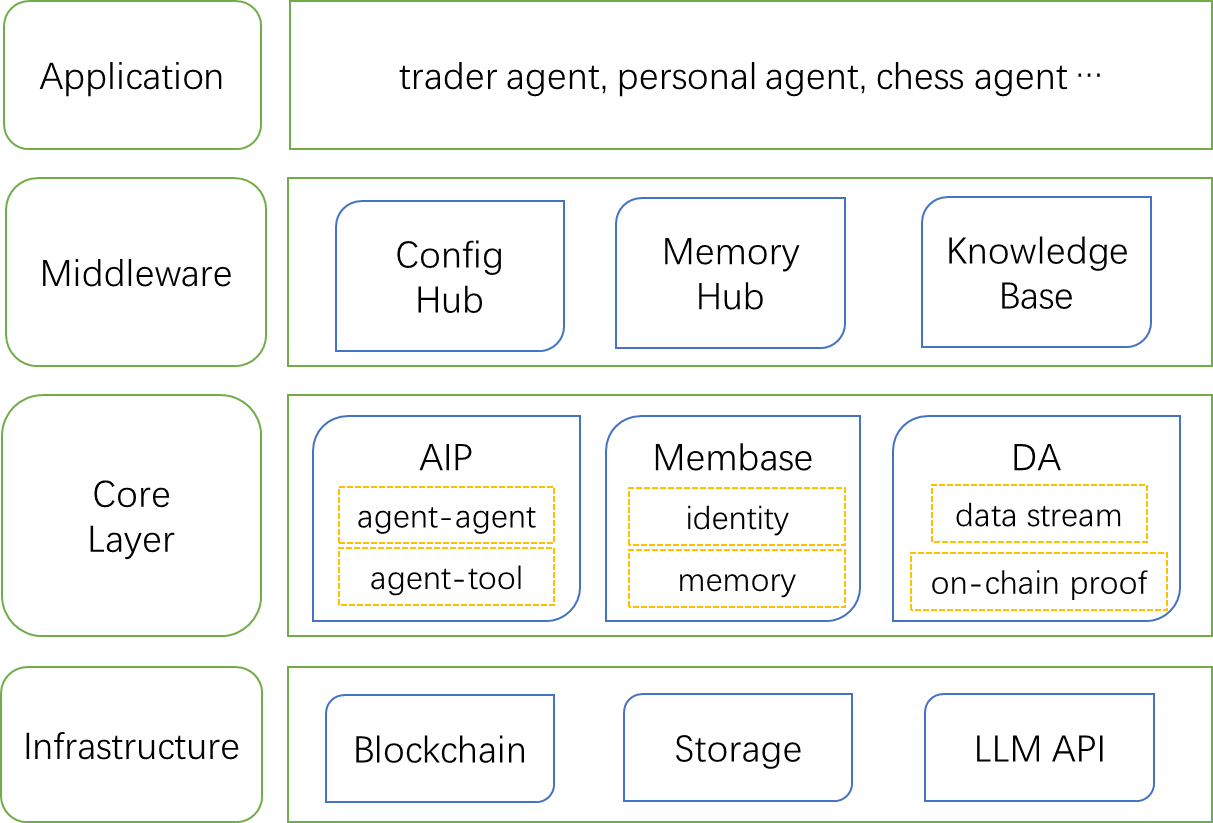
How Unibase works: architecture overview | Source: Unibase docs
It operates through three core infrastructure pillars that transform a simple chatbot into an autonomous professional:
1. Membase: The Decentralized Brain
Membase is the storage vault for an agent’s long-term memory. Unlike a browser’s history that lives on one computer, Membase is decentralized.
• How it works: It uses zk-SNARKs (Zero-Knowledge proofs) to store an agent’s history. This means the agent can prove it knows your preferences, like your risk tolerance for trading, without actually revealing your sensitive data on the public blockchain.
• Practical Use: If you use a Travel Agent on one app and a Finance Agent on another, Membase allows them to share a common memory of who you are, creating a seamless experience across the entire Open Agent Internet.
2. AIP 2.0: The Universal Language for Machines
The Agent Interoperability Protocol (AIP) is the social and economic rules for agents. It allows a Research Agent to find, talk to, and hire a Trading Agent.
• Semantic Naming: Instead of complex wallet addresses like 0x123..., agents find each other using natural language handles, e.g., @market-analyst.
• Universal Compatibility: It is built to work with Anthropic’s Model Context Protocol (MCP), the gold standard for how AI models talk to external tools, ensuring Unibase agents can connect to Google Calendar, Slack, or DeFi protocols instantly.
3. Unibase DA: The High-Speed Data Highway
AI agents require massive amounts of data to make decisions. Standard blockchains are often too slow to provide this. Unibase DA (Data Availability) is a specialized highway built for heavy AI workloads.
• The Data: It supports an incredible 100GB/s throughput, fast enough to handle millions of agent interactions at once.
• The Speed: It offers sub-100ms latency, meaning an agent can remember a piece of information and act on it in less than a tenth of a second, faster than a human can blink.
Unibase's Trust and Payment Layer
To make these agents truly autonomous, Unibase adds two final real-world tools:
• Identity (ERC-8004): Think of this as a digital passport. It proves an agent is authorized by you to make a trade, preventing impersonation attacks in the machine economy.
• x402 Payments: A native payment rail for machines. It uses the HTTP 402 Payment Required code to let agents pay each other in $UB tokens for sub-tasks like paying a Writer Agent to draft a report without you needing to click Approve for every cent spent.
What Is the Open Agent Internet and How Does Unibase Leverage It?
The Open Agent Internet represents Unibase's primary addressable market, moving beyond human-centric browsing to a web built for machine collaboration. By providing the Golden Triangle of Identity (ERC-8004), Memory (Membase), and Payment (x402), Unibase transforms AI from stateless, disposable tools into persistent digital entities. This infrastructure allows agents to retain context and build long-term reputations across different platforms, rather than resetting after every session.
This ecosystem removes the logistics tax of human intervention, enabling agents to discover, hire, and pay one another autonomously via the AIP 2.0 protocol. According to 2026 industry forecasts, this machine-to-machine coordination reduces the cost and time of complex workflows by up to 35%. Unibase acts as the essential middleware, allowing specialized agents, such as DeFi bots and research tools, to be composed like Legos to solve multifaceted problems in real-time.
For investors, the Open Agent Internet is the fundamental value driver for the $UB token. As the network scales toward its One Million Memory Nodes goal, $UB functions as the reserve currency for this economy, settling payments for brain power for storage and transportation for interoperability. With partnerships already reaching over 1 million users via 4AI and Blazpay, Unibase is positioning itself as the primary operating layer for the autonomous web.
What Is the UB Token?
The UB token is the native utility asset that secures and powers the Unibase network. It is not just a speculative asset but a necessary fuel for the machine-to-machine economy:
• Protocol Fees: UB is used to pay for agent deployment, memory writes/reads in Membase, and cross-agent communication bandwidth.
• Governance (veUB): Based on the ve(3,3) model, holders can lock UB to participate in protocol governance and direct ecosystem rewards.
• Node Staking: In Q1 2026, the One Million Memory Nodes initiative requires node operators to stake UB to provide decentralized storage, potentially reducing the circulating supply.
• Knowledge Mining: Users and agents can earn UB by contributing valuable prompts and reusable knowledge to the shared memory layer.
What Is Unibase (UB) Tokenomics?
Unibase has a fixed maximum supply of 10 billion UB, with approximately 2.5 billion tokens (25%) currently in circulation as of February 2026.
UB Token Distribution
• Community (35%): Allocated for rewards and knowledge mining, with a 5% unlock at the Token Generation Event (TGE) and the remainder vesting over 29 months.
• Ecosystem (10%): Dedicated to project growth and partnerships; subject to a 6-month cliff followed by a 24-month linear release.
• Treasury (20%): Reserved for long-term development and grants; follows a 6-month cliff and 24-month linear vesting schedule.
• Team & Advisors (18%): Locked for a 6-month cliff, then released linearly over 24 months to ensure long-term alignment.
• Marketing (10%): Used for user acquisition and branding; 4.25% unlocked at TGE, with the rest vesting over 4 months.
• Liquidity (5%): Fully unlocked at TGE to provide immediate market depth on exchanges.
• Binance Alpha (2%): Fully unlocked at launch for early adopters and community incentives.
Unibase (UB) vs. Traditional AI Frameworks: Key Differences
| Feature | Traditional AI (ChatGPT/Claude) | Unibase (UB) |
| Memory | Stateless (Session-based) | Persistent & Decentalized (Membase) |
| Identity | Centralized Accounts | On-chain & Cryptographic (ERC-8004) |
| Interoperability | Siloed API access | Universal via AIP 2.0 & MCP |
| Payments | Credit Cards / Fiat | Micropayments via UB (x402) |
| Verification | Black-box | ZK-Verified on-chain |
Traditional AI frameworks like LangChain or AutoGPT function primarily as inference wrappers, focusing on prompt chaining and data retrieval from centralized LLMs. While effective for chat, they are fundamentally stateless; each session starts from zero, requiring manual human context-loading. In contrast, Unibase shifts the focus to composable action by providing a persistent, decentralized brain through Membase. This allows agents to retain complex user preferences across different platforms, while ZK-verification ensures this data remains private and auditable on-chain, a level of transparency impossible in the black-box architecture of traditional models.
Practically, Unibase replaces the fragmented, fiat-heavy model of Web2 AI with a native, machine-to-machine economy. While traditional agents are restricted by siloed API access and manual subscription payments, Unibase utilizes the AIP 2.0 protocol and x402 payments to enable autonomous discovery and instant micro-settlement in $UB. This high-performance infrastructure, supporting 100GB/s throughput, allows agents to hire one another and manage their own data assets without human oversight. For developers, this means moving from building simple chatbots to deploying self-evolving digital entities capable of independent financial execution.
How to Trade Unibase (UB) on BingX
Leverage BingX AI to monitor volume spikes and sector rotation, ensuring you enter UB positions with data-backed precision.
Buy, Sell, or Hold UB/USDT on Spot Trading for Long-Term Accumulation
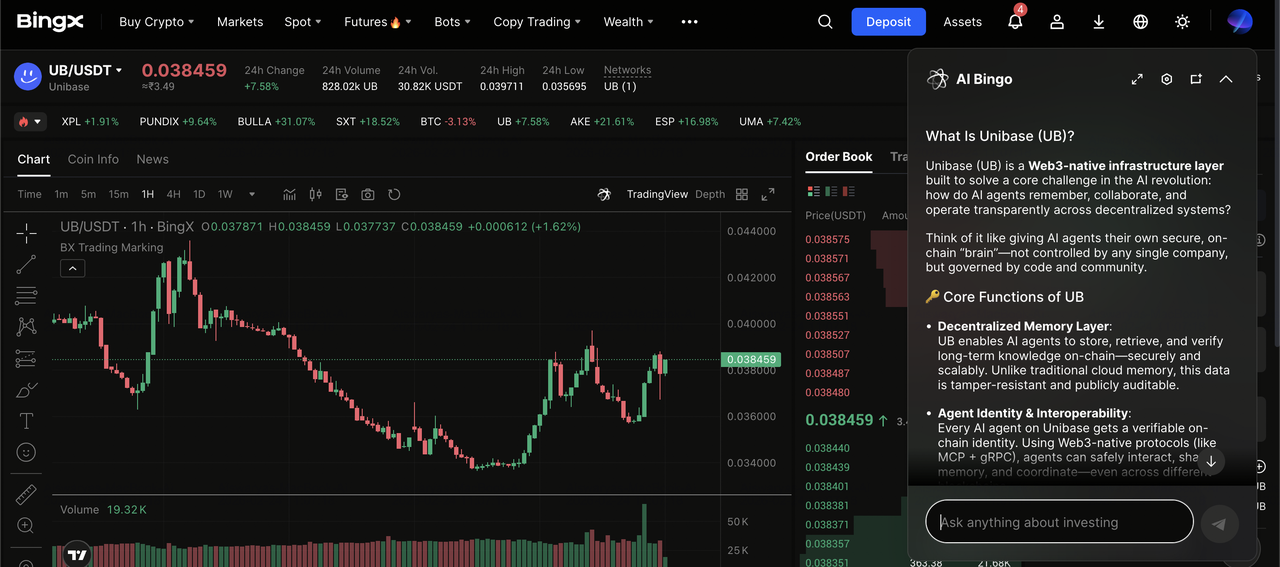
UB/USDT trading pair on the spot market powered by BingX AI insights
For investors looking to hold UB as the Open Agent Internet expands, the BingX Spot market provides a seamless entry point.
1. Fund Your Account: Ensure your Spot Account is funded with USDT.
2. Find the Pair: Search for UB/USDT in the Spot market interface.
3. Execute Your Strategy: Use a Limit Order to buy near support levels or a Market Order to capture immediate volume-led momentum.
Long or Short UB Perps in the Futures Market
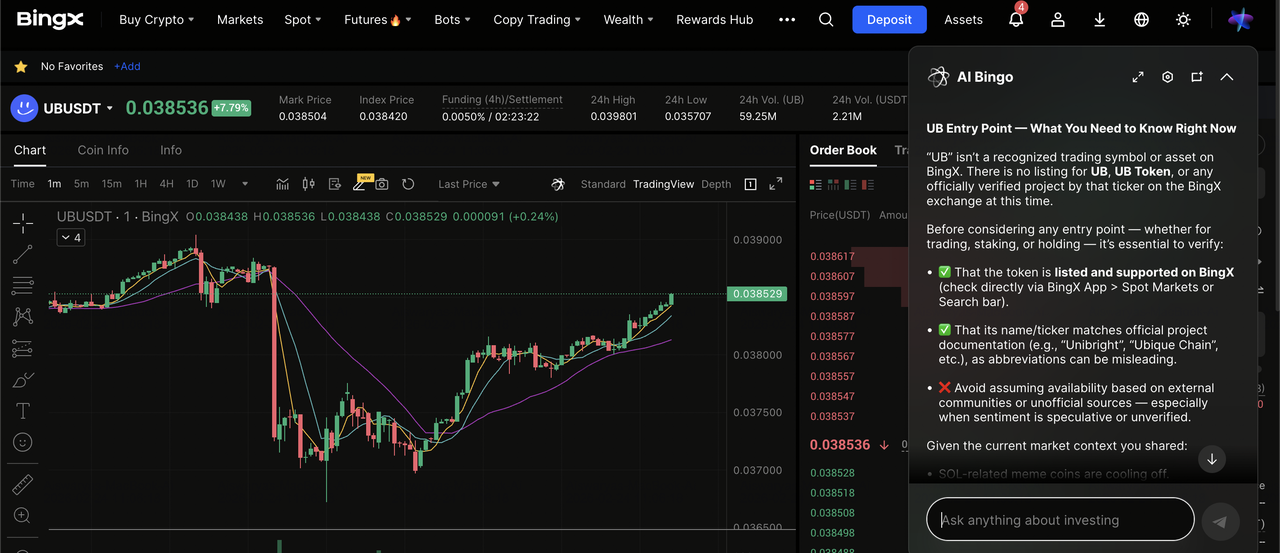
UB/USDT perpetuals on the futures market featuring BingX AI insights
Traders looking to capitalize on UB’s high-beta moves or hedge against AI sector volatility can utilize UB/USDT perpetual contracts.
1. Transfer Margin: Move USDT into your Futures Account.
2. Monitor Technicals: Watch for a breakout above key resistance levels; volume confirmation is key here.
3. Manage Risk: Use strictly defined Stop-Loss (SL) orders, especially during high-volume periods where 10–15% flash moves are common.
3 Key Considerations Before Trading Unibase (UB)
While Unibase is a leader in the AI infrastructure narrative, it carries specific risks:
1. Vesting and Supply Inflation: Be aware of the Team and Advisor unlocks starting in early 2026. Substantial new demand from agent activity is required to absorb this incoming supply.
2. Narrative Sensitivity: UB acts as a high-beta proxy for the AI sector. It is highly sensitive to news from OpenAI, NVIDIA, or major protocol upgrades on the BNB Chain.
3. Roadmap Execution: The long-term value depends on the successful rollout of AIP 2.0 in Q2 2026. Monitor the number of active agents and memory-write metrics on-chain.
Conclusion: Is Unibase the Memory of the Future?
Unibase is transitioning from a conceptual framework to a functional operating layer by deploying the technical and economic plumbing necessary for autonomous AI. Through its integration of Membase, AIP 2.0, and Unibase DA, the project addresses the critical infrastructure gap between simple AI reasoning and real-world execution. By standardizing machine-to-machine communication and providing a native tokenized payment rail, Unibase is positioning its modular stack as the primary memory and identity layer for the emerging autonomous agent economy.
While the project’s recent volume surge and independent price action suggest market validation for the AI memory narrative, investors must maintain a disciplined strategy. Like many high-beta assets in the decentralized AI (DeAI) sector, $UB remains subject to extreme price volatility and narrative-driven swings. The long-term value of the token is fundamentally tied to the consistent onboarding of third-party service providers and the execution of the One Million Memory Nodes initiative. Users should strictly adhere to risk management protocols, as the sector is highly sensitive to external technological shifts and broader market liquidity flows.