

UnifAI Network is the foundational infrastructure for the era of Agentic Finance, moving beyond simple automation to create a multi-chain execution layer for autonomous intelligence. Launched to bridge the gap between technical DeFi complexity and retail accessibility, UnifAI provides the tools for AI agents to discover, compose, and execute financial strategies in real-time across networks like Solana, BSC, and Polygon.
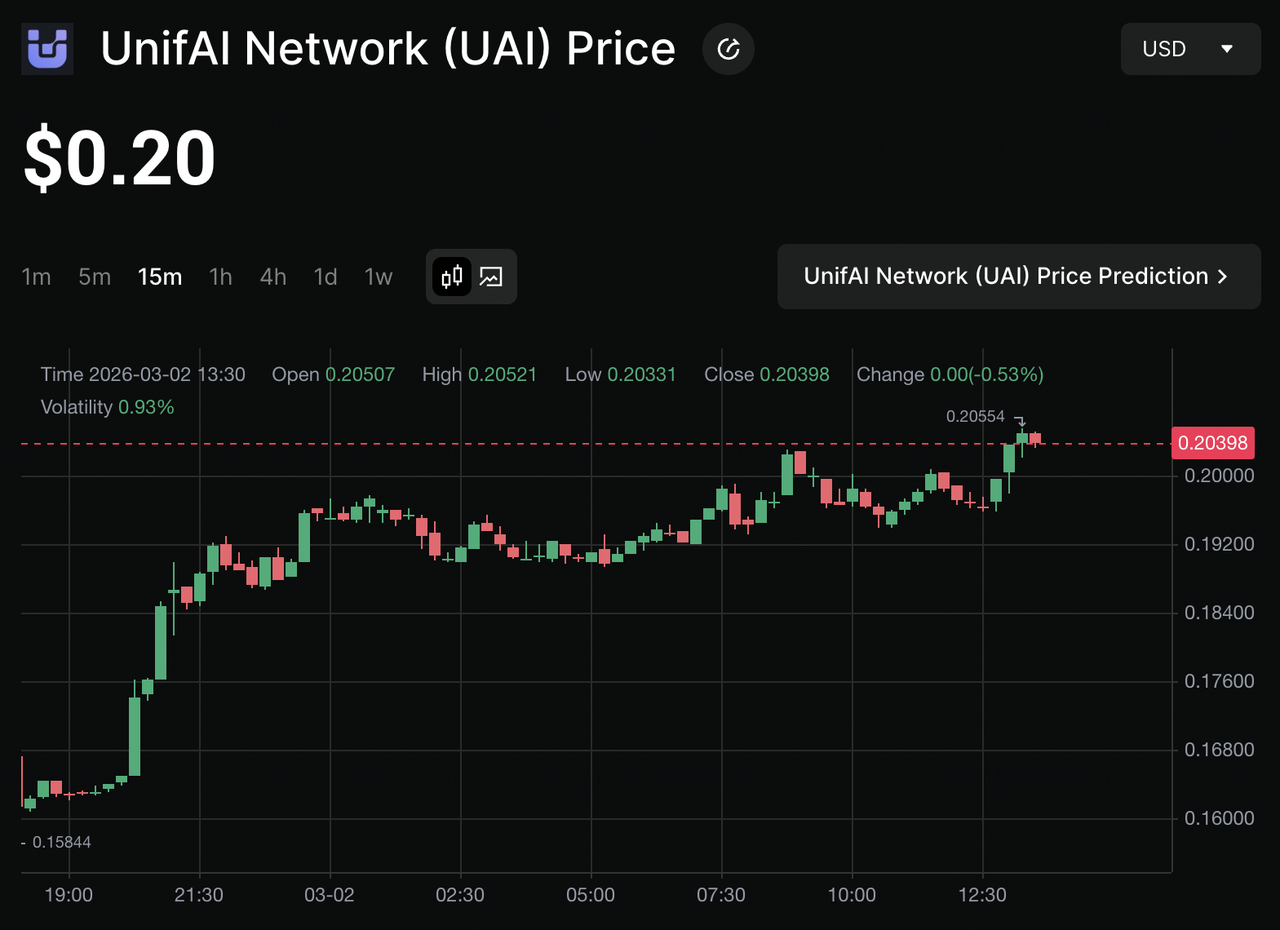
UnfiAI price chart on BingX shows UAI token's 20+% surge in March 2026
$UAI is currently a frontrunner in the AI + DeFi (DeFAI) narrative. In early March 2026, the token surged over 21% in 24 hours, sharply outperforming a broader market mired in Extreme Fear. While traditional assets struggled, UAI benefited from a significant sector rotation into AI tokens, holding critical support as capital flowed into agentic protocols capable of producing real-world on-chain results.
This article breaks down the modular architecture of UnifAI, the utility of the $UAI token, and a guide on how to trade UAI on BingX.
What Is UnifAI (UAI) and How Does It Work?
UnifAI functions as a deterministic execution layer that abstracts the heavy lifting of decentralized finance. Built on a modular three-layer system, it enables AI agents to perform multi-step on-chain transactions, from liquidity provision (LPing) to perpetual trading, without requiring user coding skills. It operates through three core pillars:
• Infrastructure Layer: The open-source backbone that enables cross-chain AI autonomy. It features an AI-native protocol for tool discovery, ensuring that agents can find and use new DeFi primitives as they launch.
• Tooling Layer: A developer-centric suite providing an Open SDK and as-a-Service modules, TaaS, DaaS, AaaS. It introduces Vibe Coding, an intuitive interface that simplifies the creation of complex financial logic.
• Application Layer: The user-facing portal featuring the Agentic Wallet, an AI financial advisor, and a Strategy Marketplace where users can share, copy, and monetize automated trading bots.
By utilizing Dynamic Tool Discovery, UnifAI agents don't follow static rules. Instead, they search for the most efficient liquidity pools or yield opportunities at runtime, reducing the time for DeFi research and execution from hours to under 20 minutes.
What Are UnifAI’s Autonomous Agents?
In the UnifAI ecosystem, agents are not just chatbots; they are sovereign financial executors. These agents use Large Action Models (LAMs) to interact directly with smart contracts.
The platform utilizes a Trigger + Action framework for strategy creation:
1. Triggers: Can be time-based, e.g., Every 4 hours, or price-based, e.g., If SOL hits $150.
2. Logic: Agents scan parameters like FDV, TVL, 24h fees, and Jupiter Organic Scores.
3. Action: The agent executes the trade, manages slippage, and sets real-time stop-losses or take-profit orders.
Common deployments include Meteora DLMM automation on Solana and Polymarket endgame strategies on Polygon, where agents hunt for high-probability outcomes in prediction markets just before settlement.
What Is the UAI Token?
The UAI token is the native utility and governance asset that fuels the UnifAI economy. With a fixed maximum supply of 1 billion tokens, it acts as the primary medium of exchange:
• Service Access: Users pay UAI to access premium AI agents, advanced analytical tools, and the strategy marketplace.
• Staking and Incentives: Users stake UAI to secure the network and earn a share of protocol revenue. Stakers also receive discounts on platform fees.
• Governance: Token holders vote on protocol upgrades, new chain integrations, such as the recent Hyperliquid expansion, and treasury allocations.
• Strategy Rewards: Strategy creators earn 30% of the fees generated by users who copy their bots, often settled in UAI or stablecoins.
What Is UnifAI ($UAI) Tokenomics and Strategic Allocation?
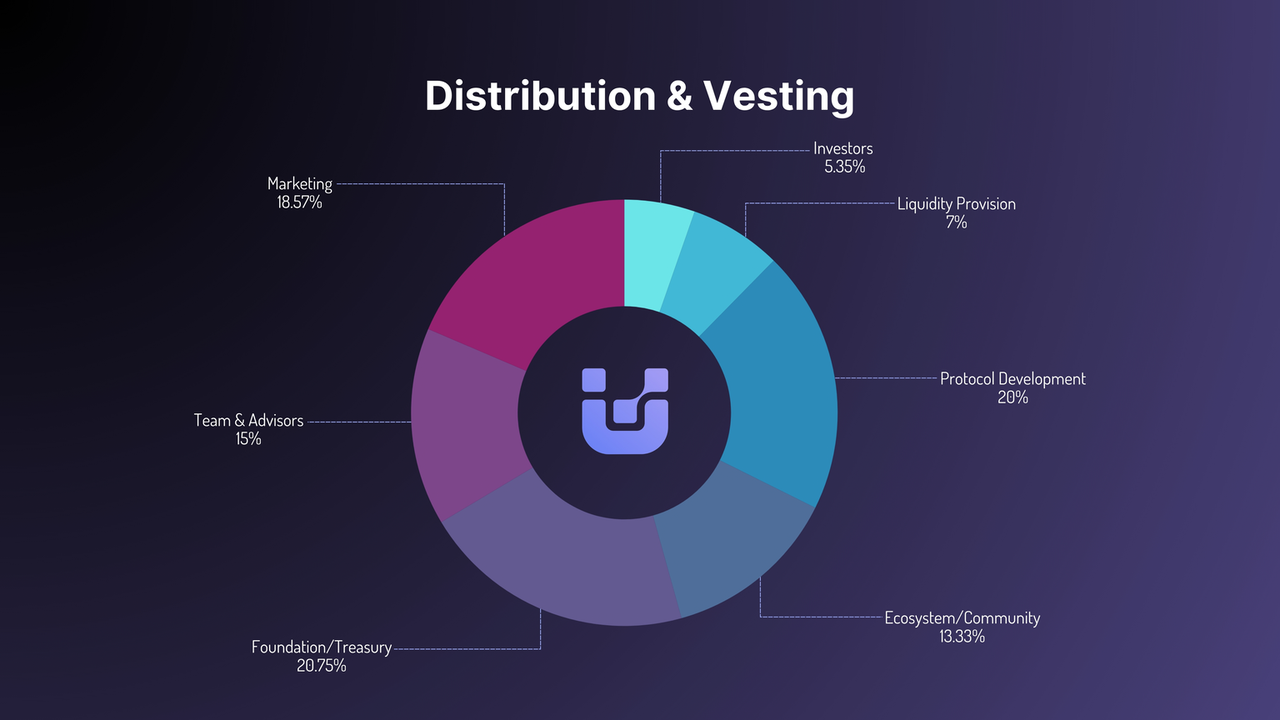
UAI token allocation | Source: UnifAI docs
The $UAI token operates with a fixed maximum supply of 1,000,000,000 (1 billion) tokens on the BNB Smart Chain (BSC), ensuring a hard cap against long-term inflation.
• Foundation and Treasury (20.75%): Allocated for long-term operational resilience, strategic research, and ecosystem grants.
• Protocol Development (20.00%): Powers continuous technical advancement, including AI agent integration and infrastructure scaling.
• Marketing (18.57%): Dedicated to global awareness, educational campaigns, and strategic brand partnerships.
• Team and Advisors (15.00%): Incentivizes core contributors with a 48-month vesting schedule to align with project longevity.
• Ecosystem and Community (13.33%): The lifeblood of growth, funding user airdrops, developer grants, and engagement rewards.
• Liquidity (7.00%): Reserved to ensure stable trading environments across centralized and decentralized exchanges.
• Investors (5.35%): Allocated to early strategic partners with a 24-month vesting period to ensure market stability.
UnifAI vs. Traditional DeFi Automation: Key Differences
| Feature | Traditional Automation (Bots) | UnifAI (UAI) |
| Logic Type | Static / If-This-Then-That | Dynamic / Autonomous Reasoning |
| Tool Discovery | Hard-coded APIs | Real-time "On-the-Fly" Discovery |
| User Interface | Technical / Script-heavy | Natural Language / Vibe Coding |
| Execution | Centralized Scripts | Deterministic On-Chain Agents |
| Ecosystem | Siloed Protocols | Unified (100+ Integrated Protocols) |
Traditional DeFi automation relies on static, If-This-Then-Then-That (IFTTT) logic and hard-coded API integrations, which often fail when a protocol updates its smart contract or UI. These legacy systems are restricted by siloed environments, requiring manual reconfiguration for every new liquidity pool or yield farm. In contrast, UnifAI utilizes Dynamic Tool Discovery and an orchestration layer that wraps over 100+ DeFi protocols into composable, atomic blocks. This allows agents to reason through execution paths at runtime, reducing the time required for complex multi-step strategy deployment from hours of manual coding to under 20 minutes via natural language Vibe Coding.
The performance gap is most visible in execution efficiency and risk management. While traditional bots are often blind to broader market health, UnifAI agents evaluate real-time on-chain data, such as Jupiter Organic Scores (>= 65), 24h fee-to-TVL ratios (>= 1%), and token age. For example, in Meteora DLMM strategies, UnifAI agents can independently manage Bid-Ask ranges and trigger real-time stop-losses, e.g., -8% PnL, or take-profits, +10% PnL, removing the latency of human intervention. This shift from static scripts to Large Action Models (LAMs) has enabled UnifAI to power over 116,000 wallets and process $123 million in trading volume, significantly outperforming the rigid scalability of traditional DeFi bots.
How Does UnifAI Differ From Other DeFAI Projects?
UnifAI (UAI) distinguishes itself from broader DeFAI projects by shifting the paradigm from AI-assisted advice to Agentic Finance, autonomous, on-chain execution without human intervention. While other AI crypto projects like Bittensor (TAO) focus on decentralized model training and Artificial Superintelligence (FET) target multi-purpose autonomous economic agents, UnifAI is a specialized execution layer that has already integrated with over 100+ leading DeFi protocols and 45+ specialized platforms like Polymarket and Hyperliquid.
Practically, this results in a complete AI → Execution → Optimization loop; where a traditional bot might simply notify a user of an arbitrage gap, UnifAI agents utilize Large Action Models (LAMs) to autonomously navigate slippage, optimize gas, and execute multi-step rebalancing across chains. This high-velocity adoption is reflected in its data: despite a smaller market cap than its peers, the network has processed over $123 million in trading volume and supports 116,000+ active wallets, achieving a User-to-Value density that is significantly higher than most general-purpose AI infrastructure projects.
How to Trade UnifAI (UAI) on BingX
Navigate the evolving digital asset landscape by trading UAI with BingX AI, which provides real-time market insights, trend analysis, and data-driven signals to support smarter trading decisions. BingX AI combines professional-grade tools with intuitive execution, helping you analyze momentum, manage risk, and buy/sell UnfiAI (UAI) more confidently in fast-moving markets.
Buy or Sell UAI/USDT on Spot Trading
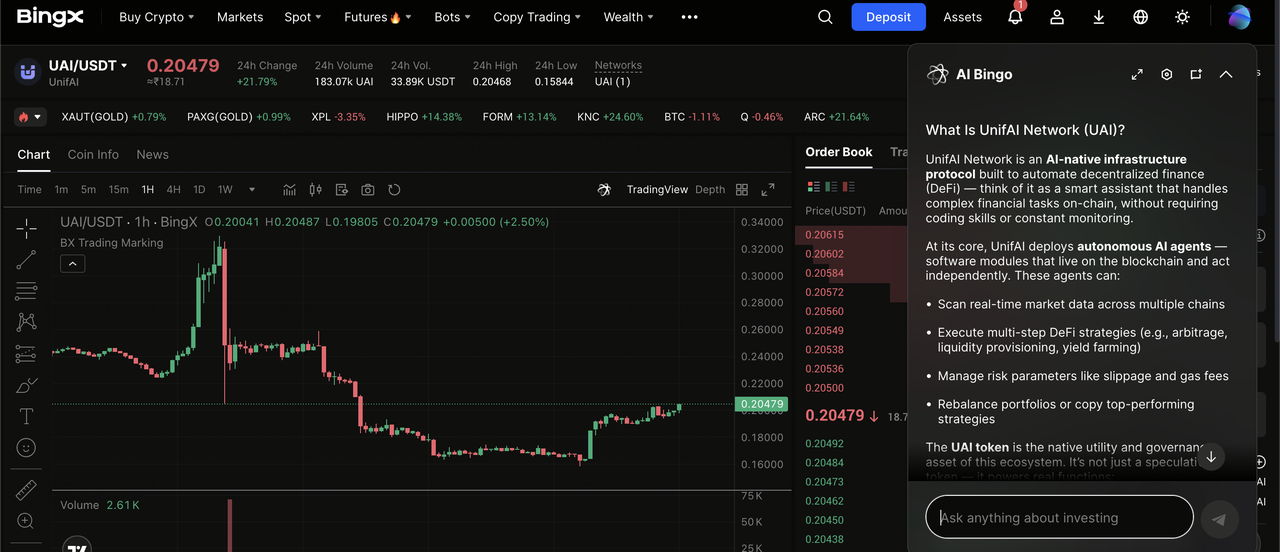
UAI/USDT trading pair on the spot market featuring BingX AI insights
For long-term holders looking to capitalize on the growth of the Agentic Finance ecosystem:
1. Fund Your Account: Deposit USDT into your BingX account.
2. Search for UAI: Navigate to the Spot Market and search for UAI/USDT.
3. Execute Trade: Use a Limit Order to buy at key support levels or a Market Order for immediate entry.
Trade UAI Perps for Narrative Volatility
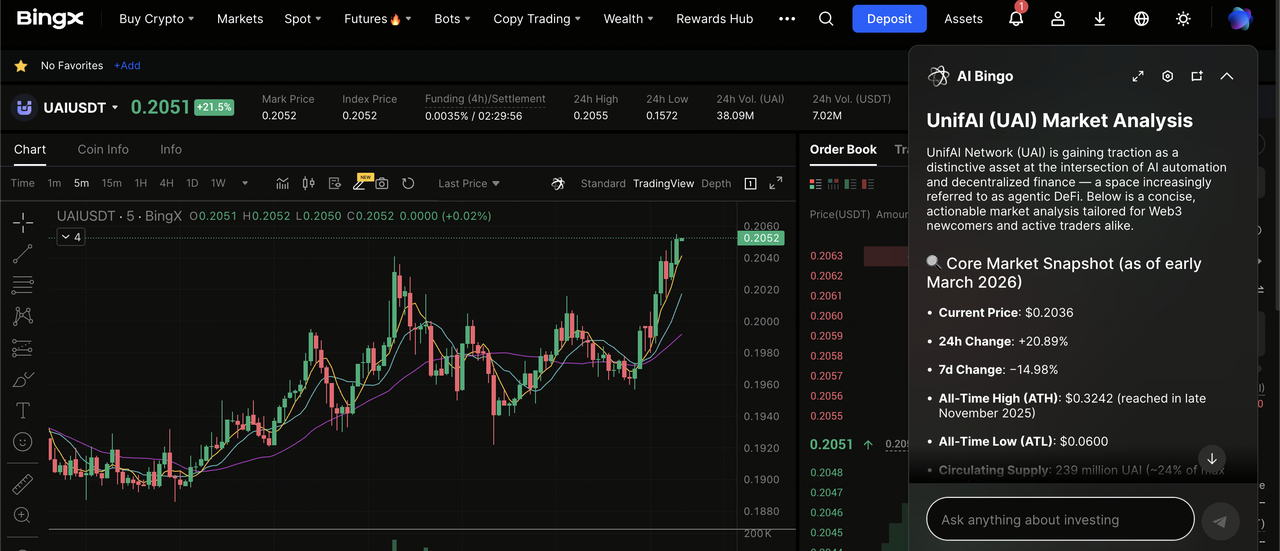
UAI/USDT perpetuals on the futures market with BingX AI analysis
Traders looking to hedge or leverage UAI's high beta moves:
1. Transfer Margin: Move USDT to your Futures Account.
2. Select Pair: Open the UAI/USDT Perpetual contract.
3. Manage Risk: Set Stop-Loss and Take-Profit levels to protect against the volatility typical of new AI launches.
4 Key Considerations Before Trading UAI
Before committing capital to the Agentic Finance narrative, investors must evaluate the technical floors and ecosystem metrics that differentiate UnifAI’s fundamental value from short-term speculative hype.
1. Narrative-Driven Volatility and Sector Beta: UAI acts as a high-beta proxy for the AI sector, recently gaining 18.48% while the broader market dipped 1.24%. This decoupling is often driven by the Altcoin Season Index, which is currently at 34 as of March 2026; however, UAI remains hypersensitive to AI News Catalysts, frequently showing a strong correlation with major milestones from OpenAI or NVIDIA earnings. Traders should watch for a shift in the Fear & Greed Index, sitting currently at 15, as a move toward Neutral could accelerate UAI’s upside momentum.
2. Tokenomics and Supply Overhang: With a circulating supply of 239 million or 23.9% of the 1 billion total supply, UAI has a significant Fully Diluted Valuation (FDV) gap. Investors must account for the 13.33% community allocation, which is distributed via quarterly airdrops and ecosystem incentives. These scheduled unlocks can create predictable sell pressure, meaning price appreciation requires organic demand to outpace the incoming supply of roughly 33.3 million tokens per quarter.
3. Agentic Adoption and Sticky TVL: Unlike purely speculative tokens, UAI’s long-term floor price is mathematically anchored to platform utilization. Investors should track three specific KPIs: the growth of Total Wallets from over 116,000, cumulative Trading Volume of over $123 million, and the deployment of active strategies past 3,600 in March 2026. A stagnation in UnifAI's Strategy Creator Rewards, the 30% fee-share for bot developers, would be a primary red flag for fundamental value decay, regardless of broader AI sector trends.
4. Smart Contract and Execution Risk: Because UnifAI agents operate as active executors rather than passive advisors, they are subject to unique technical risks. While the protocol features a fault-tolerant infrastructure, the Agentic nature means users are trusting AI models to manage slippage and gas optimization. Any exploit in the underlying Unified API or a failure in the Dynamic Tool Discovery mechanism could lead to cascading liquidation risks across integrated protocols like Meteora or Drift.
Conclusion: Is UnifAI the Future of the Agentic Web in DeFi?
UnifAI Network (UAI) marks a transition from passive DeFi tools to active financial intelligence. By centralizing the fragmentation of multi-chain protocols into a single, agent-led execution layer, the project provides a scalable framework for Agentic Finance. With its proven capacity to manage over $123 million in volume across diverse platforms like Polymarket and Meteora, UnifAI is positioning itself as an essential plumbing layer for the next generation of the interactive web, where AI handles the heavy lifting of on-chain operations.
While the project’s growth to 116,000+ wallets reflects strong market fit, it remains a high-risk asset within a nascent and speculative sector. Investors must weigh the platform's utility against significant risks, including smart contract vulnerabilities, potential execution errors by autonomous models, and the upcoming dilution from the remaining 76% of non-circulating supply. As with all AI-themed infrastructure, the long-term sustainability of $UAI depends on its ability to maintain technical superiority over emerging competitors while navigating the inherent volatility of the crypto-AI narrative.