


The financial landscape of March 2026 marks a definitive era in the maturation of fintech. We have entered a structural shift where the boundaries between traditional equity markets and decentralized finance (DeFi) are no longer distinct. At the epicenter of this transformation is Vladimir Tenev, the co-founder and CEO of Robinhood Markets, Inc. (HOOD).
As of March 10, 2026, Tenev’s financial standing reflects a sophisticated recovery following the Bitcoin Polar Vortex, a severe market correction that tested the resilience of crypto-exposed entities. His real-time net worth is estimated at $4.8 billion, a figure that serves as a barometer for the global adoption of tokenized assets, artificial intelligence, and next-generation financial infrastructure.
Who Is Vladimir Tenev?
Source: X
Vladimir Tenev is a Bulgarian-American entrepreneur who disrupted Wall Street by co-founding Robinhood in 2013. Born to parents who worked for the World Bank, Tenev’s background heavily influenced his mission to democratize finance.
Under his leadership, Robinhood moved from a simple commission-free trading app to a comprehensive financial super-app. By 2026, Tenev has pivoted the company toward three high-growth pillars: Layer-2 blockchain infrastructure (Robinhood Chain), Institutional-grade prediction markets, and Mathematical AI. Beyond his role at Robinhood, Tenev is the Executive Chairman of Harmonic, an AI startup focused on Mathematical Superintelligence, further diversifying his wealth beyond the public markets.
Read more: Robinhood Stock Forecast 2026: $130 Hyper-Growth or Valuation Correction?
How Did Vladimir Tenev Build His Wealth?
Tenev’s path to a multi-billion-dollar fortune is built on four primary foundational pillars:
1. The Robinhood Equity Matrix
The primary engine of Tenev’s wealth remains his ownership stake in Robinhood Markets (HOOD). As of early 2026, he maintains a direct ownership interest of approximately 5.2% to 6.2% of the company's total outstanding shares.
Crucially, Tenev’s influence is amplified by a multi-class share system. While his equity stake is around 6%, his voting power is estimated at 24%. This ensures long-term governance stability, allowing him and co-founder Baiju Bhatt (who holds 40% voting power) to maintain absolute control over the firm’s strategic direction.
3. Performance Stock Units (PSUs) and Milestones
The 2025 fiscal year was a watershed moment for Tenev’s personal balance sheet. As Robinhood’s share price surged toward its October 2025 all-time high of $152.46, several market-based price milestones were triggered:
- September 2025 Settlement: Tenev settled 6,915,914 PSUs after the stock met the $101.50 price goal.
- Liquidity Realization: Through sell-to-cover transactions and Rule 10b5-1 trading plans, Tenev realized hundreds of millions of dollars in liquidity in early 2026, which has been reallocated into private tech ventures and Palo Alto real estate.
3. The Crypto Infrastructure Pivot
By March 2026, Robinhood evolved into a major infrastructure player. The launch of the Robinhood Chain (an Ethereum Layer-2 network) and the $200 million acquisition of Bitstamp in 2025 transformed the company from a retail broker into a blockchain operator. This shift rerated the company’s valuation multiples, directly boosting Tenev’s net worth during the 2025 bull cycle.
4. Harmonic AI: The Private Wealth Buffer
A critical component of Tenev’s 2026 wealth is his involvement in the AI sector. He co-founded Harmonic, which raised $120 million in Series C funding at a $1.45 billion valuation in late 2025. Tenev’s founding stake in this unicorn provides an estimated $200 million to $400 million in private equity value that is decoupled from stock market volatility.
Vladimir Tenev's Net Worth in 2026: Key Estimates
Based on the latest financial data and market valuations as of March 2026, Vladimir Tenev’s net worth is a dynamic figure primarily driven by his equity in the public markets and his growing private technology portfolio.
| Metric | March 10, 2026 Status | Qualitative Influence |
| Real-Time Net Worth | *$4.8 Billion | Reflects recovery from Bitcoin Polar Vortex |
| Daily Change | -$45 Million (-0.94%) | Tied to HOOD stock & BTC correlation |
| Primary Asset | Robinhood (HOOD) Equity | ~6% stake; 24% voting power |
| Private Equity | Harmonic AI | Executive Chairman; $1.45B valuation |
| Forbes Ranking | #881 (Real-Time) | #934 (Annual List) |
| Self-Made Score | 8 out of 10 | Son of immigrants; academic background |
As of March 2026, Vladimir Tenev’s net worth is estimated at $4.8 billion, a figure that reflects both his 6% equity stake in Robinhood Markets (HOOD) and his strategic pivot into high-growth private sectors. While his direct ownership is substantial, his true influence is magnified by a multi-class share system that grants him 24% of the total voting power, allowing him to steer the company’s transition from a retail broker into a blockchain and AI infrastructure leader. His wealth faced significant volatility during the early 2026 Bitcoin Polar Vortex, where HOOD stock maintained a near-perfect 0.96 correlation with Bitcoin, though his liquid position was bolstered by the settlement of nearly 7 million Performance Stock Units (PSUs) following a 2025 share price peak of $152.46.
Beyond the public markets, Tenev has built a critical wealth buffer through his role as Executive Chairman of Harmonic, a Mathematical Superintelligence AI startup valued at $1.45 billion following a Series C round in late 2025. This private stake provides Tenev with a unique hedge against the fluctuations of the retail trading sector, representing between $200 million and $400 million in value that remains decoupled from daily stock market swings. Combined with the launch of the Robinhood Ventures Fund I (RVI) on the NYSE, Tenev’s 2026 financial profile is no longer just a reflection of trading volume, but a diversified portfolio of Layer-2 blockchain rails, institutional-grade prediction markets, and error-free generative AI.
The Bitcoin Polar Vortex and Tenev's Wealth Volatility
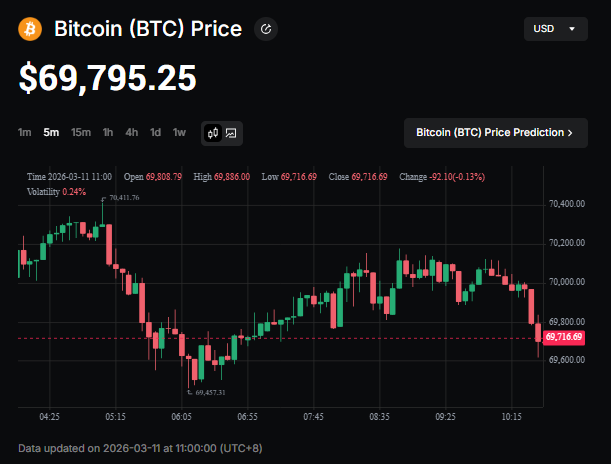
The relationship between Vladimir Tenev’s wealth and the cryptocurrency market became nearly symbiotic in early 2026. This connection was tested by the Bitcoin Polar Vortex, a severe 45.5% correction where Bitcoin fell from its $126,000 peak to support levels near $64,000.
Source: Bitcoin (BTC) Price | BingX
Statistical Correlation: HOOD vs. BTC
One of the most striking insights of 2026 is the tightening correlation between Robinhood's stock price and Bitcoin.
- 2025 Correlation: 0.53 (Moderate)
- Early 2026 Correlation: 0.96 (Near-lockstep)
Even though crypto trading represents only 17%–20% of Robinhood’s revenue, market sentiment treats HOOD as a proxy for retail risk appetite. Consequently, Tenev’s net worth now fluctuates in real-time with the "Fear and Greed Index" of the crypto markets. During the height of the Vortex in February 2026, Tenev saw a multi-hundred-million-dollar reduction in his equity value within a single quarter.
Vladimir Tenev's Strategic Diversification: Beyond Traditional Brokerage
To protect his fortune from the "boom-and-bust" nature of crypto, Tenev has led Robinhood into infrastructure projects designed to build recurring, non-speculative revenue.
1. The Robinhood Chain (L2)
Launched on February 10, 2026, this Ethereum Layer-2 network (built on Arbitrum Orbit) allows for:
- 24/7 Trading: Tokenized stocks and ETFs that trade on crypto time.
- Institutional Clearing: Using the Bitstamp acquisition to own the rails of settlement.
2. Prediction Markets and Family Office Services
Tenev identified prediction markets as a supercycle opportunity. Within one year of launch, Robinhood customers traded 9 billion contracts. Furthermore, the March 4, 2026 Take Flight event introduced Family Finance tools, including a $695 annual-fee Platinum card, targeting the $124 trillion generational wealth transfer.
3. Robinhood Ventures Fund I (RVI)
On March 6, 2026, the RVI Fund listed on the NYSE, raising $658.4 million. This fund gives retail users exposure to private giants like Databricks and SpaceX. For Tenev, this adds a management fee revenue vertical that stabilizes the company's (and his) income.
How Does Vladimir Tenev’s Wealth Compare to Other Leaders?
To understand Vladimir Tenev’s position in the 2026 financial hierarchy, we must view him alongside the titans of both the Muskonomy and the native digital asset space. Tenev occupies a unique middle ground: while he lacks the astronomical capital of infrastructure kings like Elon Musk or the exchange-driven dominance of Changpeng Zhao (CZ), his $4.8 billion valuation places him in the top tier of fintech architects who are successfully tokenizing traditional finance.
| Leader | Primary Entity | Est. Net Worth (March 2026) | Primary Strategy |
| Elon Musk | Tesla / SpaceX / xAI | $839 Billion | Industrial AI & SpaceX 2026 IPO Anticipation |
| Changpeng Zhao (CZ) | Binance | $110 Billion | 90% Equity stake in global liquidity engine |
| Pavel Durov | Telegram | $17 Billion | Direct ownership of 900M+ user social layer |
| Brian Armstrong | Coinbase | $7.4B – $14.2B | Public exchange equity & Base L2 growth |
| Justin Sun | TRON / HTX | $9.15B – $11.1B | Stablecoin utility (USDT) & TRX founder stake |
| Vladimir Tenev** | Robinhood | $4.8 Billion | Public equity + Harmonic AI private stake |
| Cameron Winklevoss | Gemini | $2.6 Billion | Gemini exchange equity & BTC treasury |
| Jesse Powell | Kraken | $1.0B – $1.5B | Significant founder stake in Kraken exchange |
| Anatoly Yakovenko | Solana Labs | $0.5B – $1.2B | SOL token holdings & Solana Labs equity |
| Arthur Hayes | BitMEX / Maelstrom | $200M – $400M | Derivatives pioneer; Maelstrom venture fund |
Analysis: Public Equity vs. Ecosystem Ownership
Vladimir Tenev’s wealth profile most closely parallels that of Brian Armstrong and Jesse Powell, as all three have fortunes heavily tied to the valuation of centralized exchange platforms. However, Tenev is increasingly moving toward the ecosystem model pioneered by Justin Sun and Anatoly Yakovenko. By launching the Robinhood Chain, Tenev is attempting to capture the same Layer-1 utility that has driven Sun’s wealth to the $10 billion mark through TRON’s stablecoin dominance. While Tenev’s net worth is currently more modest than Armstrong’s, his diversification into Harmonic AI gives him a private buffer that many crypto-only founders lack.
In contrast, leaders like Pavel Durov and Elon Musk operate on a scale that transcends the crypto market. Musk’s record-breaking $839 billion fortune is driven by a closed-loop of AI, aerospace, and automotive equity, while Durov’s $17 billion reflects the massive valuation of Telegram as it integrates crypto-payments for its billion-user base. Tenev’s strategy in 2026 is to bridge these two worlds, using Robinhood as the regulated gateway that brings the Musk-level institutional assets (like tokenized SpaceX shares) to the Yakovenko-level decentralized rails.
Key Risks Affecting Tenev’s Net Worth in 2026
- Macroeconomic Volatility: Surging oil prices and geopolitical tensions in early 2026 have pressured the financial sector, keeping HOOD stock in a digestion period between $75 and $85.
- Regulatory Scrutiny of L2s: As the Robinhood Chain gains traction, the SEC’s stance on tokenized securities remains a primary risk factor for the company's valuation.
- Revenue Sustainability: Investors are concerned about whether the 129% year-over-year transaction growth seen in 2025 can be maintained as market activity stabilizes in 2026.
Conclusion
Vladimir Tenev’s net worth in 2026 is a testament to the power of the fintech-to-crypto pivot. At an estimated $4.8 billion, he has successfully transitioned from a "growth-at-all-costs" founder to a disciplined architect of a profitable financial super-app.
While his fortune remains subject to the volatile swings of the "Bitcoin Polar Vortex," his strategic investments in L2 blockchain infrastructure, private market access, and Mathematical AI have created a diversified wealth base. If Robinhood hits the consensus analyst target of $130.10 per share by the end of 2026, Tenev’s net worth could easily surpass the $8 billion mark, cementing his status as a foundational figure in the global digital economy.
Related Reading
- What are Robinhood Tokenized Stocks HOODX (xStocks) and HOODON (Ondo) and How to Buy?
- Top AI Tokenized Stocks to Watch in 2026
- Who Are the Top 10 Crypto Billionaires in 2026? Net Worth and Portfolios Revealed
- What Is Cameron Winklevoss’s Net Worth in 2026?
- What Is Arthur Hayes' Net Worth in 2026?
- Vitalik Buterin’s Net Worth in 2026: How Much Does the Ethereum Co-Founder Own?
- What Is Michael Saylor’s Net Worth in 2026?
FAQs on Vladimir Tenev’s Net Worth
1. How much is Vladimir Tenev worth in 2026?
As of March 10, 2026, his net worth is estimated at approximately $4.8 billion.
2. Does Vladimir Tenev own Bitcoin?
While most of his wealth is in Robinhood equity, Robinhood itself is a major holder of Bitcoin, and Tenev’s personal portfolio includes diversified digital assets and private AI ventures.
3. What is the Robinhood Chain?
It is an Ethereum Layer-2 network launched in 2026 that allows for the trading of tokenized traditional securities and instant settlement, aiming to bridge Wall Street and DeFi.
4. How does the price of Bitcoin affect Tenev's net worth?
In early 2026, the correlation between Robinhood stock (HOOD) and Bitcoin reached 0.96. This means Tenev’s net worth moves almost in lockstep with the crypto market.
5. What is Harmonic?
Harmonic is an AI startup co-founded by Tenev that focuses on "Mathematical Superintelligence" to solve AI hallucinations. It was valued at $1.45 billion in late 2025.