What Is Shardeum (SHM) Autoscaling Blockchain and How Does It Work?

  • Advanced
  • 10 min
  • Published on 2025-05-13
  • Last update: 2025-10-16
 
Shardeum (SHM) is the world’s first auto-scaling, EVM-compatible Layer 1 blockchain designed to deliver infinite scalability and rock-steady low fees. As of May 2025, Shardeum is already powering over 150 ecosystem projects with more than 171,000 public validators, 1.4 million community members, and 1.2 million accounts, having processed over 81 million transactions and deployed 247 thousand contracts. It does all this while keeping fees low and predictable, automatically scaling to meet demand, and ensuring every transaction is processed in strict chronological order so no one can jump the line.
In this guide, you’ll learn what makes Shardeum unique, how it works, and why it could power the next wave of Web3 applications.

What Is Shardeum (SHM)?

Shardeum (SHM) is an Ethereum-compatible Layer 1 blockchain that uses dynamic state sharding and a hybrid Proof-of-Stake (PoS) + Proof-of-Quorum consensus to scale linearly as more nodes join. That means throughput grows in direct proportion to network size, so transaction speed and capacity never plateau. With full EVM compatibility, you can deploy your existing Solidity or Vyper contracts on Shardeum without modification, while enjoying lifetime low fees and instant finality.

Key Features of the Shardeum Network

Shardeum’s architecture delivers a suite of advantages that make it ideal for developers and users alike:
 
• Infinite Low Fees: Because shards autoscale with demand and transactions run in parallel, network overhead stays constant. That means fees never spike during peak usage; developers and users always pay predictable, minimal gas costs.
 
• Linear Throughput: Adding more validator nodes directly increases Shardeum’s capacity. Double the nodes, double the transactions per second (TPS). This linear relationship ensures the network can grow to support any scale of Web3 application.
 
• Atomic Cross-Shard Composability: Even though transactions run on separate shards, Shardeum maintains atomicity: you can bundle complex operations, like swapping tokens across multiple contracts, in a single transaction without risk of partial failure or extra coordination steps.
 
• EVM-Compatibility: Shardeum speaks the same language as Ethereum. Any Solidity or Vyper contract can be deployed unchanged, and all familiar developer tools (Hardhat, Truffle, MetaMask) work out of the box. This seamless migration saves time and unlocks low-fee scaling for existing dApps.

How Shardeum Works: Solving the Blockchain Trilemma with Core Technology
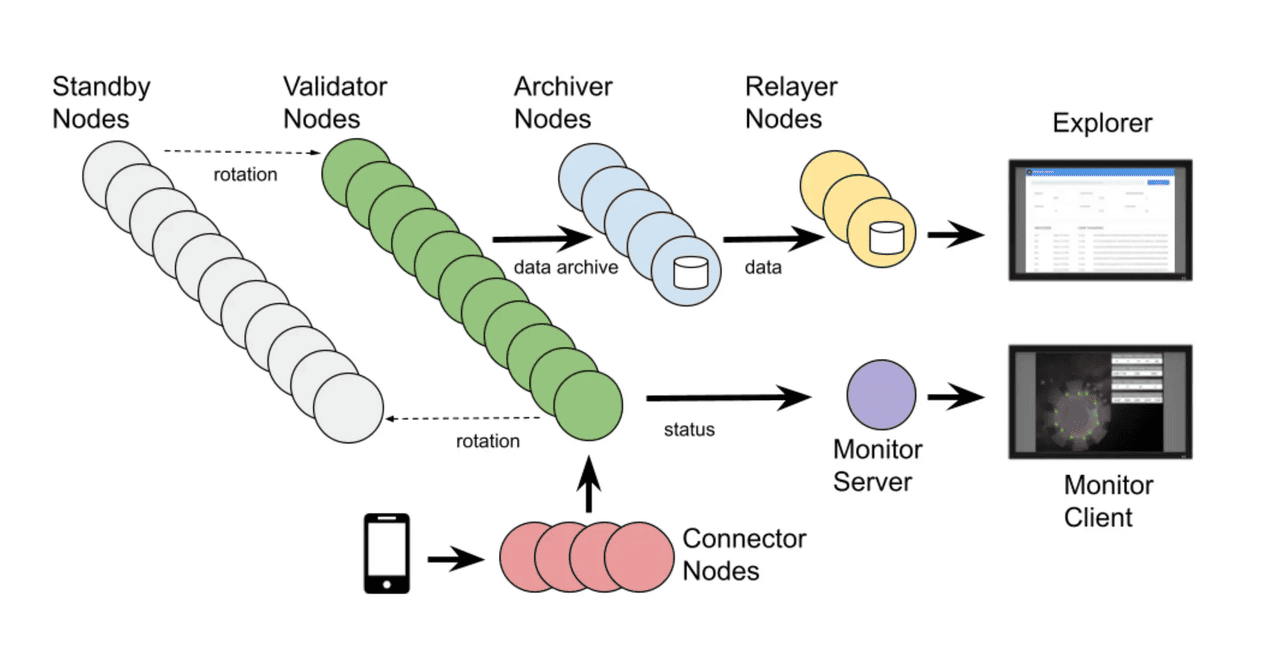
An overview of nodes in the Shardeum network | Source: Shardeum whitepaper

Most blockchains must sacrifice one of three pillars - scalability, security, or decentralization, to optimize the others, a challenge known as the “blockchain trilemma.” Shardeum shatters this trade-off by weaving together three core technologies:

1. Scalability via Dynamic State Sharding & Auto-Scaling: Shardeum splits its network into many parallel “shards,” each processing its own subset of transactions and smart contracts. Rather than funneling every transaction down a single chain, shards work simultaneously, so as you add more validator nodes, throughput scales linearly. On top of that, Shardeum measures network load every minute and automatically spins shards up or down to match real-time demand. The result? Throughput and fees remain stable even under heavy load.

2. Security through Hybrid PoS + PoQ Consensus: To secure these parallel shards, Shardeum combines Proof-of-Stake (PoS) for Sybil-resistance with Proof-of-Quorum (PoQ) for instant, trustless validation within each shard. Validators stake SHM to participate, then collect “quorum receipts” from over 50% of shard members to finalize transactions. An automatic validator rotation mechanism further hardens the network against targeted attacks, ensuring fast finality without compromising safety.

3. Decentralization with Permissionless Validator Access: Anyone - from students to seasoned developers, can run a Shardeum node with minimal hardware. There are no gatekeepers or special requirements: just stake the minimum SHM and join a shard. This open access boosts the number of active validators, spreads transaction processing across a global community, and guarantees that no single party can dominate the network.

Key Projects in the Shardeum Ecosystem

Shardeum’s autoscaling design has attracted a vibrant ecosystem of applications. Here are three standout dApps live on Shardeum testnet:
 
• Swapped Finance DEX: As the leading decentralized exchange on Shardeum, Swapped Finance handled over 60 million transactions and onboarded 52,000+ active validators during its incentivized testnet phase. With a 0.3% swap fee and ~0.21675% returned to liquidity providers, it demonstrates how high-throughput trading and farming can thrive without fee spikes.
 
• Dotshm.me DNS: Dotshm.me brings human-readable names (for example, alice.shm) to Shardeum wallets, eliminating error-prone hex addresses. To date, users have minted over 1 million .shm domains, with 11,000+ early “OG” roles awarded for community participation. This service streamlines on-chain interactions and invites ecosystem growth through its “invite and earn” referral tasks.
 
• Spriyo.xyz NFT Marketplace: Spriyo.xyz has quickly become the go-to hub for minting, bidding, and trading NFTs on Shardeum’s low-fee testnet. It hosts 3,000+ collections and over 120,000 minted items, while its Guild community counts 4,600+ members. By combining minimal gas costs with instant finality, Spriyo makes NFT creation and discovery accessible to everyone.

What Is SHM Tokenomics and Utility?

Shardeum’s native token, SHM, powers every aspect of the network’s economy. Here’s how it’s designed:

SHM Token Supply & Distribution

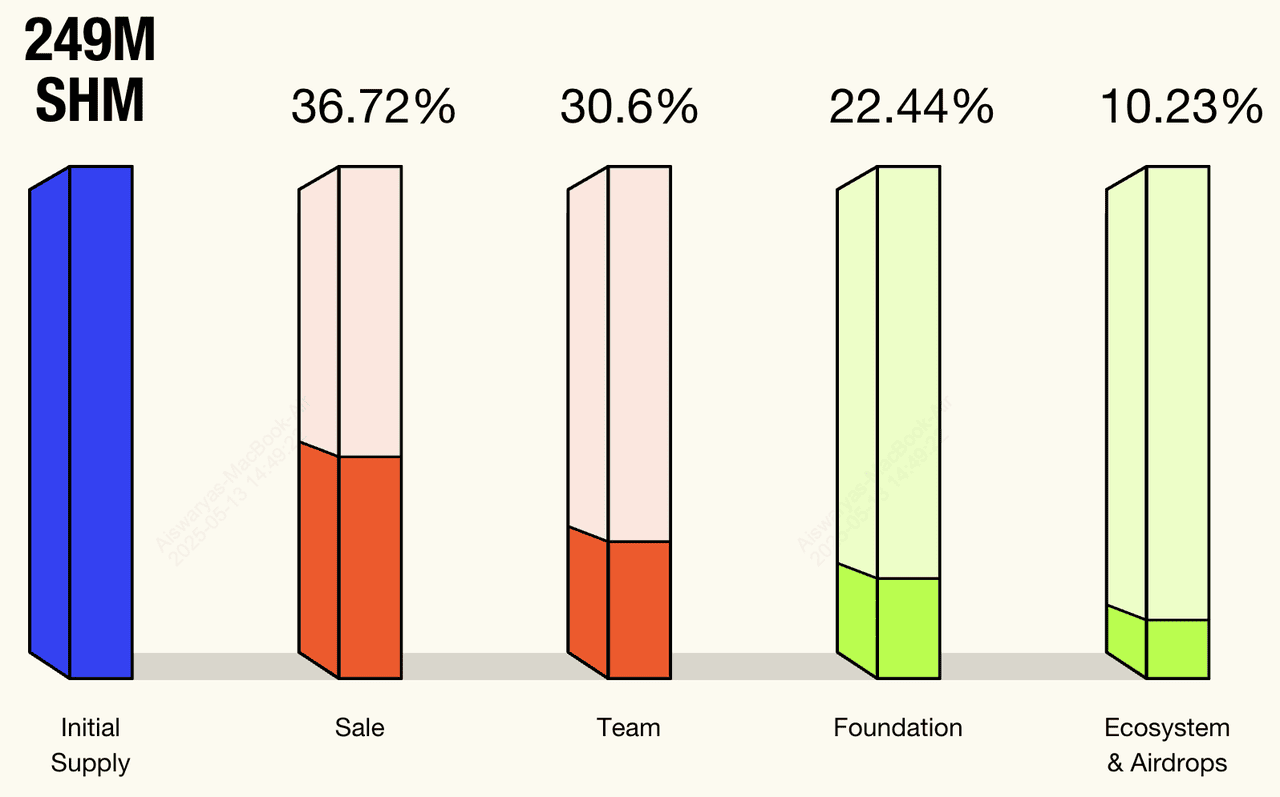
Shardeum (SHM) token allocation | Source: Shardeum

At launch, Shardeum issued 249 million SHM. These tokens are allocated to align incentives and fund growth:

• 36.72% (91.4 M) for public and private sale, vesting over 2 years after a 3-month cliff

• 30.60% (76.2 M) reserved for the core team, also vesting over 2 years after a 3-month cliff

• 22.44% (55.9 M) held by the foundation to support development and ecosystem grants

• 10.23% (25.5 M) dedicated to ecosystem incentives and airdrops

SHM Token Use Cases

Here are some of the key use cases for the SHM token within the Shardeum ecosystem:

1. Gas Fees: Every transaction and smart contract execution on Shardeum requires SHM, ensuring network operations remain sustainable.

2. Staking: Validators lock up SHM as collateral to secure the network and earn block rewards.

3. Governance: SHM holders vote on protocol upgrades and parameter changes, giving the community full control over Shardeum’s future.

4. Rewards: From validator payouts to developer grants, SHM is distributed to participants who contribute to network growth.

To maintain long-term value, 100% of on-chain fees are burned. As more transactions occur, the circulating SHM supply decreases, creating a deflationary pressure that can support price appreciation over time.

How to Earn SHM Tokens on Shardeum

There are several ways to earn SHM by actively participating in the Shardeum network:
 
1. Run a Validator Node: Stake the minimum required SHM to join a shard and validate transactions. Every time your node confirms a block or quorum, you earn SHM rewards proportional to your stake and uptime. This is the most direct way to both support network security and earn tokens.
 
2. Provide Liquidity on Swapped Finance: Deposit SHM and other ERC-20 tokens into Swapped Finance’s liquidity pools. You’ll earn a share of the 0.3% swap fees (about 0.21% APR at current volumes), paid out in real time. More trading volume on Shardeum means higher yields for LPs.
 
3. Participate in Testnet & Airdrop Campaigns: Shardeum regularly runs incentivized testnets, like Atomium and Sphinx, where early adopters earn SHM for staking, staking pool participation, and completing network tasks (gas sponsorship tests, cross-shard transactions). Keep an eye on official announcements for new reward opportunities.
 
4. Join Community Bounties & Hackathons: Developers and security researchers can earn SHM by finding bugs through bounty programs or building dApps in Shardeum-sponsored hackathons. Bounties often reward SHM for critical vulnerability reports or for contributing high-quality code and tutorials.
 
5. Engage in Governance & Referrals: Some proposals offer SHM incentives for voting or referring new network participants. By engaging in on-chain governance forums or completing referral tasks, you can qualify for token grants that support decentralization and community growth.

How to Buy and Store SHM on BingX

Ready to get your hands on SHM? Follow these simple steps to purchase SHM on BingX and learn how to keep it safe:
 
1. Log in to BingX: Open your BingX app or web dashboard and sign in.
 
2. Navigate to Spot Trading: Select “Spot” from the bottom menu (mobile) or top navigation (web).
 
3. Search SHM/USDT: In the market search bar, type “SHM” and choose the SHM/USDT pair.
4. Choose Order Type:
• Market Order: Buy instantly at the current price.
• Limit Order: Set your desired price; the order fills only when SHM reaches that level.
 
5. Enter Amount & Confirm: Specify how much SHM you want to purchase, review fees, and tap “Buy SHM.” Your SHM balance will appear in your Spot Wallet immediately (market) or when the price condition is met (limit).
 
Your purchased SHM is stored in your BingX Spot Wallet by default. Enable two-factor authentication (2FA) and withdrawal whitelist in Settings for added security. For self-custody, add the Shardeum network to MetaMask, import SHM’s contract address, and transfer tokens from BingX. Always keep your private keys and seed phrase offline.

Shardeum Roadmap: What's Next?

Shardeum’s mainnet went live in Q2 2025, ushering in the world’s first autoscaling EVM Layer 1 blockchain. Curious where Shardeum is headed? Here’s a quick look at the milestones Shardeum has achieved and the upgrades on the horizon.
 
• Full Auto-Scaling Implementation (Q3 2025): Complete rollout of on-chain shard adjustments, enabling seamless capacity increases without manual intervention.
 
• Smart-Contract Enhancements (Q3–Q4 2025): Expanded EVM feature support, including advanced opcode integration and gas sponsorship.
 
• Cross-Chain Bridges (Q4 2025): Secure, permissionless bridges to Ethereum and other networks, unlocking native interoperability and liquidity flows.

Conclusion

Shardeum’s dynamic state sharding, auto-scaling, and hybrid PoS + PoQ consensus deliver impressive scalability, low fees, and genuine decentralization, while full EVM compatibility opens the door for seamless dApp migration. With a clear tokenomics model and a growing ecosystem of projects, SHM offers practical utility for both developers and users. You can easily trade SHM on BingX and secure it in your exchange wallet or a self-custodied EVM wallet like MetaMask. Remember, cryptocurrency investments are volatile and carry regulatory uncertainties—always do your own research and invest only what you can afford to lose.

Related Reading